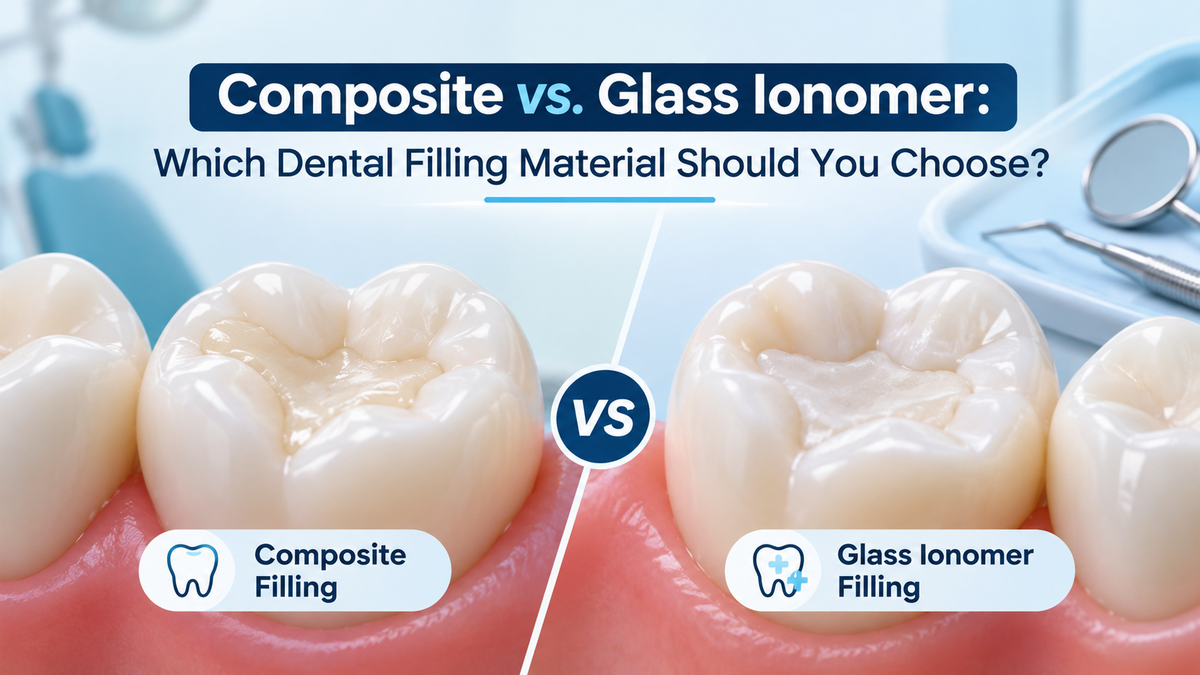
Choosing between composite resin and glass ionomer cement is an important decision in restorative dentistry. Both materials have useful clinical applications, but they differ in esthetics, adhesion, fluoride release, wear resistance, and handling.
Composite resin is widely used when a natural-looking restoration and good wear resistance are priorities. Glass ionomer materials offer chemical adhesion to tooth structure and fluoride release, making them useful in selected restorative and preventive applications. Resin-modified glass ionomers extend these properties for specific procedures, including the cementation of crowns and bridges.
For dental professionals, the question is not simply which material is better. It is which material best matches the tooth, cavity, patient, and clinical procedure?
This guide compares composite and glass ionomer materials, explains when each may be appropriate, and highlights three products available from Sky Dental Supply: FujiCEM 2, CX Plus Glass Ionomer Cement, and GC Fuji TRIAGE.
What Is Composite Resin?
Composite resin is a tooth-colored restorative material made from a resin matrix combined with inorganic filler particles. It is designed to restore tooth structure while providing an appearance that closely resembles natural enamel and dentin.
Most direct composite restorations require appropriate isolation, tooth preparation when indicated, an adhesive system, placement, and curing with a compatible dental curing light.
Composite is commonly used for:
Anterior restorations where appearance is important
Posterior fillings in selected cavities
Repairing chipped or fractured teeth
Replacing damaged tooth structure
Closing selected small gaps or correcting minor tooth-shape concerns
The material is available in different viscosities, shades, and formulations. The choice depends on the restoration's size, location, esthetic requirements, and expected chewing forces.
Advantages of Composite Resin
Natural appearance: Composite is available in multiple shades and translucencies to help match surrounding teeth.
Versatility: Different formulations support a range of anterior and posterior restorative procedures.
Conservative treatment options: When clinically appropriate, composite can allow restoration of damaged areas while preserving healthy tooth structure.
Polishability: Proper finishing and polishing can produce a smooth, natural-looking surface.
Limitations of Composite Resin
Composite is technique-sensitive. Contamination during bonding can compromise the restoration, and inadequate curing can affect material properties.
Polymerization shrinkage may also contribute to stress at the restoration interface. Placement technique, cavity configuration, material selection, and curing protocol all matter.
Composite does not release fluoride in the same way as conventional glass ionomer materials. Patients with elevated caries risk may therefore need a broader preventive plan, regardless of which restorative material is selected.
What Is Glass Ionomer Cement?
Glass ionomer cement is a tooth-colored material formed through a reaction between fluoroaluminosilicate glass powder and an aqueous polyacid. It can chemically bond to enamel and dentin and releases fluoride over time.
Glass ionomer products are not all interchangeable. Some are formulated for direct restorative applications, while others are designed for luting crowns and bridges, lining cavities, or protecting tooth surfaces.
Common applications for appropriate glass ionomer formulations include:
Selected restorations in primary teeth
Certain non-stress-bearing restorations
Cervical lesions and root-surface restorations
Cavity liners or bases when indicated
Luting crowns and bridges
Preventive sealing of pits and fissures with suitable products
The intended use specified by the manufacturer should guide product selection.
Advantages of Glass Ionomer
Chemical adhesion: Glass ionomer bonds chemically to tooth structure, although proper preparation and moisture management remain important.
Fluoride release: Fluoride release can support the overall caries-prevention strategy.
Useful in selected moisture-challenged situations: Some formulations tolerate moisture better than conventional resin composite bonding procedures, although they are not immune to contamination.
Different clinical formulations: Glass ionomer technology is available in restorative, luting, lining, and preventive products.
Limitations of Glass Ionomer
Conventional glass ionomer generally has lower wear resistance and fracture toughness than composite resin. It may not be the preferred option for large, heavily loaded posterior restorations.
Early moisture contamination or excessive dehydration can affect some glass ionomer formulations during setting. Following the product's instructions for placement, finishing, and surface protection is important.
Glass ionomer also generally offers less shade versatility and polishability than modern composite systems.
Composite vs. Glass Ionomer: Key Differences
Feature | Composite Resin | Glass Ionomer |
Appearance | Excellent shade-matching options | Usually more limited esthetic versatility |
Adhesion | Generally uses an adhesive bonding system | Chemically bonds to tooth structure |
Fluoride release | Does not provide conventional glass ionomer fluoride release | Releases fluoride |
Wear resistance | Generally better for stress-bearing restorations | Varies by formulation; often lower than composite |
Moisture sensitivity | Bonding requires effective isolation | Moisture tolerance varies; early setting still requires care |
Technique | Requires careful bonding and curing | Often simpler, depending on formulation |
Common applications | Anterior and selected posterior restorations | Selected restorations, liners, luting, and prevention |
Best choice | When esthetics and mechanical performance are priorities | When the product's adhesion, fluoride release, and indication fit the case |
No material is best for every patient. Cavity size, tooth location, occlusal loading, caries risk, moisture control, and manufacturer instructions should all influence the decision.
When Should Dentists Choose Composite?
Composite is often a strong option when a restoration must blend with natural tooth structure or withstand functional loading.
Anterior Teeth
For visible front teeth, shade matching and surface polish are especially important. Composite allows clinicians to layer shades and translucencies to reproduce the appearance of natural enamel and dentin.
Selected Posterior Fillings
Composite can be used for many posterior restorations when isolation, cavity design, and occlusal conditions are suitable. Larger restorations may require additional consideration of fracture risk and remaining tooth structure.
Esthetic Repairs
Composite may be appropriate for selected chipped teeth, small contour corrections, and other conservative esthetic treatments.
The clinician should assess the extent of damage and whether a direct restoration provides sufficient strength for the case.
When Should Dentists Choose Glass Ionomer?
Glass ionomer may be useful when fluoride release, chemical adhesion, or the intended application of a particular formulation makes it suitable.
Patients With Elevated Caries Risk
Fluoride-releasing materials can be considered as part of a broader caries-management strategy. However, material choice alone does not prevent future decay. Oral hygiene, diet, fluoride exposure, recall intervals, and lesion assessment remain essential.
Cervical and Root-Surface Lesions
Selected cervical and root-surface lesions may be suitable for glass ionomer, especially when access and moisture control make a conventional composite protocol challenging.
The choice depends on the lesion's location, loading, esthetic demands, and the specific material.
Primary Teeth and Selected Pediatric Procedures
Some glass ionomer formulations are useful in pediatric dentistry, including selected restorations and preventive applications. The material should match the cavity, expected lifespan, occlusal demands, and manufacturer's indications.
Luting and Preventive Applications
Glass ionomer technology also supports procedures beyond direct fillings. This is where it is important to distinguish restorative glass ionomer from luting cements and sealants.
Understanding the Three Glass Ionomer Products at Sky Dental Supply
Sky Dental Supply lists three products that can support different parts of a dental practice's restorative and preventive workflow. They do not all serve as interchangeable filling materials.
1. FujiCEM 2 Resin-Modified Glass Ionomer Cement
FujiCEM 2 from GC America is a resin-modified glass ionomer cement designed for cementing indirect restorations. The product listing describes its use with metal-, resin-, alumina-, and zirconia-based inlays, onlays, crowns, and bridges. It is supplied in a cartridge-based delivery system.
Key features include:
Resin-modified glass ionomer formulation
Automix delivery for consistent dispensing
Fluoride release
Low film thickness
Indications for selected indirect restorations
When to consider it: FujiCEM 2 is relevant when a dental practice needs a luting cement for an appropriate crown, bridge, inlay, or onlay. It is not a direct composite filling material or a general-purpose cavity filling.
Explore the product: FujiCEM 2 Resin-Modified Glass Ionomer Cement.
2. CX Plus Glass Ionomer Cement
CX Plus from Shofu Dental Corporation is an enhanced glass ionomer luting cement. Sky Dental Supply lists a triple kit and additional package options. The product information highlights a prolonged working time, low film thickness, high fluoride release, and a stated working time of approximately four minutes and ten seconds from the start of mixing.
Its features may be useful for clinicians seeking a conventional glass ionomer luting material with a workable handling window.
When to consider it: CX Plus belongs in the cementation discussion for suitable indirect restorations. It should not be confused with a direct composite filling or assumed to be indicated for every type of restoration.
Explore the product: CX Plus Glass Ionomer Cement.
3. GC Fuji TRIAGE Glass Ionomer Sealant and Surface Protectant
GC Fuji TRIAGE is a glass ionomer sealant and surface protectant designed for preventive applications, including selected newly erupted molars. Sky Dental Supply lists a package containing 50 capsules of 0.13 mL each. Product information highlights fluoride release and the ability to bond to tooth surfaces without a separate bonding agent for its indicated use.
Fuji TRIAGE is particularly relevant when discussing glass ionomer because it demonstrates that glass ionomer products can serve purposes beyond restoring a cavity.
When to consider it: It may be considered for suitable preventive sealing and surface-protection procedures, according to the manufacturer's instructions. It is not a direct replacement for composite resin in a stress-bearing cavity.
Explore the product: GC Fuji TRIAGE Capsule Package, 50 × 0.13 mL.
How to Select the Right Material for Your Procedure
Before choosing composite or glass ionomer, evaluate the following factors.
1. Identify the procedure. A direct filling, crown cementation, and preventive sealant application require different product types.
2. Assess the tooth and cavity. Consider the tooth's location, remaining structure, cavity size, and expected occlusal loading.
3. Evaluate caries risk. Fluoride-releasing materials may have a role in the preventive plan, but they do not replace comprehensive caries management.
4. Consider isolation. Composite bonding generally requires effective moisture control. Glass ionomer handling requirements vary by formulation and setting stage.
5. Review esthetic needs. Composite generally provides greater shade and translucency control for visible restorations.
6. Check product indications. Confirm the manufacturer's instructions for preparation, application, curing or setting, finishing, and compatibility.
7. Match the product to its intended purpose. Do not use a luting cement as a direct filling or a sealant as a substitute for a restorative material unless the manufacturer specifically indicates that application.
Can Composite and Glass Ionomer Be Used Together?
In selected clinical techniques, composite and glass ionomer materials may be used in the same restoration. For example, a clinician may choose a suitable glass ionomer-based material for one part of a treatment and composite for another.
These approaches require appropriate material selection and compatibility. Not every glass ionomer product is designed to be placed under composite, and the necessary conditioning or surface-protection steps vary by product.
The clinician should follow the manufacturer's instructions for the specific materials and the intended procedure rather than assuming that all products in either category can be combined.
FAQs: Composite vs. Glass Ionomer
Is composite better than glass ionomer for fillings?
Composite is often preferred when esthetics and wear resistance are important. Glass ionomer may be appropriate for selected lesions and procedures where chemical adhesion or fluoride release is beneficial. The best choice depends on the clinical situation.
Does glass ionomer release fluoride?
Yes. Conventional glass ionomer materials release fluoride, although the amount and release profile vary by formulation. Fluoride release supports—but does not replace—other preventive measures.
Can glass ionomer be used on back teeth?
Selected glass ionomer materials can be used in posterior teeth, but suitability depends on cavity size, occlusal loading, and the product's indications. Composite may be more appropriate for many stress-bearing restorations.
What is the difference between glass ionomer and resin-modified glass ionomer?
Conventional glass ionomer sets through an acid-base reaction. Resin-modified glass ionomer includes resin components that alter its setting and handling characteristics. Both categories contain products intended for different clinical uses.
Is FujiCEM 2 a filling material?
No. FujiCEM 2 is a resin-modified glass ionomer luting cement intended for appropriate indirect restorations, such as selected crowns and bridges. It is not a direct cavity filling material.
What is CX Plus Glass Ionomer Cement used for?
CX Plus is a glass ionomer luting cement. Clinicians should consult its product instructions to determine whether it is suitable for the particular restoration being cemented.
What is GC Fuji TRIAGE used for?
GC Fuji TRIAGE is a glass ionomer sealant and surface protectant intended for indicated preventive applications. It should not be treated as interchangeable with a direct restorative composite.
Which material is better for patients at high risk of cavities?
The choice depends on the lesion and clinical requirements. Fluoride-releasing glass ionomer may be useful in selected cases, while composite may be preferable when other restorative demands take priority. A comprehensive caries-prevention plan remains essential.
Final Thoughts
Composite resin and glass ionomer each have an important place in modern dentistry. Composite offers strong esthetic versatility and is widely used for direct restorations, while glass ionomer provides chemical adhesion and fluoride release for selected restorative, cementation, and preventive applications.
The key is to choose the right type of material for the intended procedure.
For indirect restorations, FujiCEM 2 and CX Plus represent glass ionomer luting options to evaluate against the restoration and manufacturer's requirements. For indicated preventive procedures, GC Fuji TRIAGE offers a different glass ionomer application as a sealant and surface protectant.
Dental professionals can explore these products through Sky Dental Supply and select materials based on clinical indication, handling preferences, and manufacturer guidance.