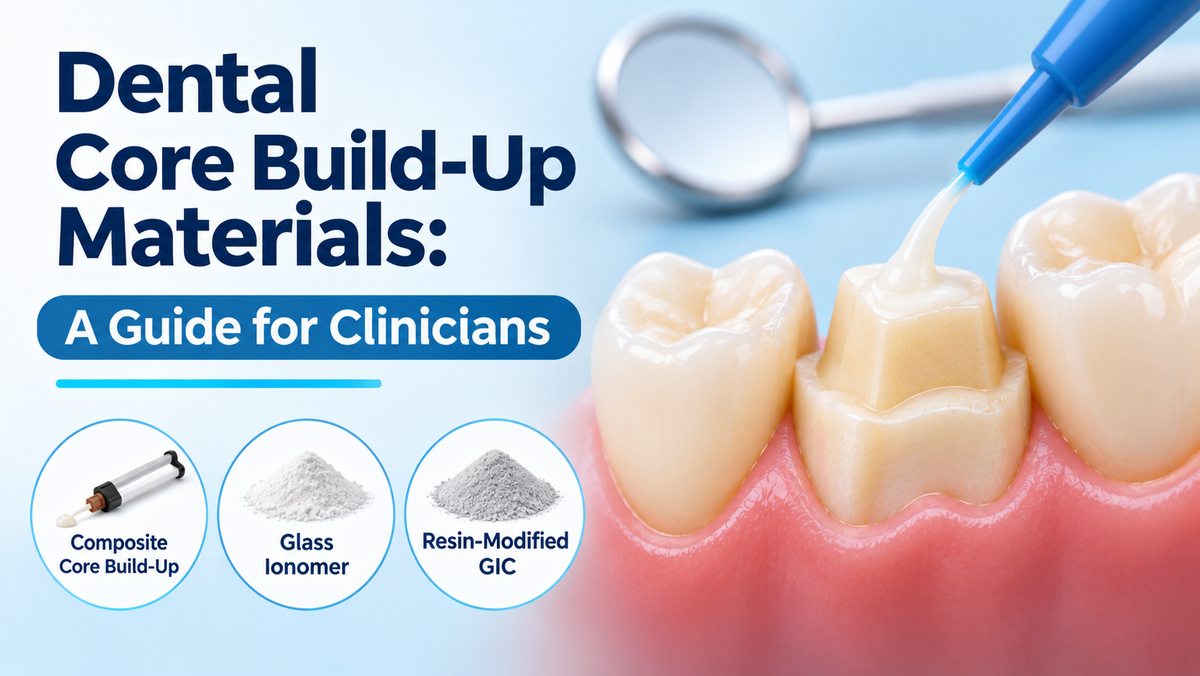
A successful crown restoration depends on more than the strength of the final prosthesis. The remaining tooth structure, the quality of the core foundation, the retention available, and the choice of restorative materials all influence long-term performance. When a tooth has lost a substantial amount of its coronal structure because of caries, fracture, a large restoration, or endodontic treatment, clinicians may need to rebuild the foundation before placing a crown.
Dental core build-up materials help replace missing coronal tooth structure and create a suitable foundation for the definitive restoration. Selecting the right material requires consideration of the remaining dentin, moisture control, mechanical demands, retention, curing method, and restorative plan.
Options include resin composite core materials, glass ionomer-based materials, resin-modified glass ionomers, and other restorative cements designed for specific indications. Posts may also be considered when the remaining tooth structure cannot adequately retain a core. However, a post does not automatically strengthen a tooth, and post placement should be based on the amount and configuration of the remaining tooth structure.
This guide explains how clinicians can evaluate core build-up options, understand the role of post-retention systems and luting cements, and select materials appropriate for different restorative situations. It also highlights products available through Sky Dental Supply, including CoreShade GlasIonomer Base Cement, seT PP resin cement, and the IntegraPost system.
What Is a Dental Core Build-Up?
A dental core build-up is a restorative foundation used to replace missing tooth structure and provide the shape and support needed for a definitive restoration, such as a crown. It is commonly considered when a tooth has extensive structural loss but remains suitable for restoration.
The core replaces the missing portion of the clinical crown. Depending on the case, it may be bonded or otherwise retained by the remaining tooth structure, with additional retention features considered when necessary.
A core build-up can help clinicians:
Re-establish the shape of a prepared tooth.
Provide a foundation for crown preparation.
Replace coronal structure lost through caries, fractures, or previous restorations.
Support restorative treatment following endodontic therapy.
Improve the ability to establish appropriate crown form and margins.
Reduce the need to remove additional healthy tooth structure simply to create restorative form.
A core material does not compensate for an unfavorable restorative prognosis. Before beginning treatment, clinicians should evaluate the remaining tooth structure, periodontal support, ferrule potential, cracks, occlusal loading, and the feasibility of achieving a durable coronal seal.
When Is a Core Build-Up Indicated?
The need for a core depends on the extent of structural loss and the requirements of the definitive restoration. A small defect may be managed with a direct restoration, while a tooth with extensive coronal destruction may require a dedicated core material before crown preparation.
1. Extensive Caries or Fracture
Large carious lesions and fractured cusps can leave insufficient structure for predictable crown preparation. After removing compromised tissue and assessing restorability, the clinician may rebuild the missing portion with an appropriate restorative material.
The material should provide suitable strength and handling characteristics while remaining compatible with the planned restorative procedure.
2. Replacement of Large Existing Restorations
Teeth with large amalgam or composite restorations may have limited remaining walls. When a crown is indicated, the existing restoration may need to be replaced or incorporated into the treatment plan, depending on its condition and the amount of sound tooth structure remaining.
3. Endodontically Treated Teeth
Endodontically treated teeth often have reduced structural integrity because of previous caries, access preparation, fractures, and restorative procedures. The need for a core depends on the remaining coronal structure and the intended final restoration.
A post may be considered when the remaining tooth structure does not provide sufficient retention for the core. It is important to remember that a post primarily helps retain the core; it does not replace missing root structure or automatically prevent root fracture.
4. Crown Preparation Following Structural Loss
A crown requires a suitable preparation form and sufficient support. Core build-up materials can help recreate missing coronal anatomy so the clinician can prepare the tooth according to the selected restorative design.
Understanding the Main Types of Core Build-Up Materials
No single material is ideal for every clinical situation. The choice depends on the restorative objective, isolation conditions, available tooth structure, and the properties required for the final restoration.
Resin Composite Core Materials
Resin composite core materials are commonly used when clinicians need a strong, shapeable foundation with appropriate handling and curing characteristics.
Depending on the product, composite core materials may offer:
High mechanical strength.
Convenient application and sculpting.
Adhesive bonding when used with a compatible bonding protocol.
Shade options that help distinguish the material during placement.
Dual-cure or self-cure options for areas where light access is limited.
Dual-cure materials may be useful when the restoration's geometry limits direct light exposure. Nevertheless, clinicians must follow the manufacturer's instructions for mixing, working time, curing, and adhesive compatibility.
Composite core materials are often considered for heavily loaded teeth and situations requiring a durable foundation. Proper isolation and correct use of the bonding system remain important.
Glass Ionomer Core Build-Up Materials
Glass ionomer materials are another option for selected core build-up and restorative indications. They chemically interact with tooth structure and can release fluoride. Some formulations are radiopaque and offer a color that makes the material easier to distinguish from dentin during preparation.
Their suitability depends on the specific formulation and the clinical demands of the case. Conventional glass ionomer materials should not automatically be treated as interchangeable with resin composite core materials, especially in areas exposed to substantial occlusal stress.
CoreShade GlasIonomer Base Cement by Shofu is one product to evaluate in this category. The manufacturer describes it as a metal-free core build-up material with high compressive strength, fluoride release, radiopacity, and a gray color that helps clinicians identify it during placement and finishing. The listed compressive strength is 147 MPa. These properties may be useful when assessing a glass ionomer-based option for an appropriate clinical indication.
View the CoreShade GlasIonomer Base Cement product page at Sky Dental Supply.
Resin-Modified Glass Ionomer Materials
Resin-modified glass ionomer materials combine glass ionomer chemistry with resin components. Depending on the product, this combination can influence handling, early strength development, and setting behavior.
However, a resin-modified glass ionomer luting cement is not automatically suitable as a core build-up material. Clinicians should verify the specific product's approved indications and mechanical properties rather than selecting a material based on its broad category alone.
Core Materials Versus Luting Cements
One of the most important distinctions in restorative material selection is the difference between a core build-up material and a luting cement.
A core build-up material replaces missing coronal tooth structure and provides a foundation for the final restoration. A luting cement is primarily used to secure an indirect restoration or a suitable post within the prepared tooth, according to its instructions for use.
Some products may be compatible with multiple restorative components, but their intended functions remain different. For example, seT PP is a self-etching, self-adhesive resin cement intended for cementation of indirect restorations and posts. It should not be presented as a direct substitute for a dedicated core build-up material.
How to Choose the Right Core Build-Up Material
Material selection should follow a structured assessment rather than relying on brand familiarity alone.
Evaluate the Remaining Tooth Structure
The number, height, thickness, and condition of the remaining walls affect the retention and support available for the core. A tooth with substantial sound coronal structure may require a different approach from one with minimal remaining walls.
Clinicians should also consider whether the final crown can achieve an appropriate ferrule when indicated. A core material cannot compensate for inadequate remaining tooth structure or an unfavorable ferrule configuration.
Consider the Location of the Tooth
Posterior teeth may experience substantial occlusal forces, making strength, support, and the overall restorative design particularly important. Anterior teeth may introduce additional aesthetic considerations, depending on the restoration and visibility of the underlying materials.
The material should be selected according to the tooth's functional demands and the manufacturer's indications, rather than assuming that one type of core material is suitable for all teeth.
Assess Moisture Control
Moisture control is important for many adhesive restorative procedures. Contamination can compromise bonding and affect clinical performance. Some materials may be more tolerant of certain handling conditions than others, but no material should be used outside its instructions simply because isolation is challenging.
Before selecting a product, consider whether predictable isolation can be achieved and whether the recommended adhesive or conditioning protocol is practical for the case.
Review Curing Requirements
Core materials may be light-cured, self-cured, or dual-cured. The choice should reflect the accessibility of the material to the curing light and the depth or configuration of the preparation.
For dual-cure products, confirm that the selected bonding agent is compatible with the curing chemistry. Follow the manufacturer's specified curing times and avoid assuming that surface exposure alone guarantees complete polymerization throughout the material.
Check Radiopacity and Identification
Radiopacity can help clinicians distinguish restorative materials from surrounding structures on radiographs. A contrasting shade may also help during core placement and preparation by making the boundary between the core and natural tooth structure easier to identify.
These characteristics are useful selection factors, but they should be considered alongside strength, retention, handling, and the product's intended use.
Product Spotlight: CoreShade GlasIonomer Base Cement
CoreShade GlasIonomer Base Cement from Shofu is designed for a metal-free core build-up and is formulated to be distinguishable from natural tooth structure.
According to the product information, its features include:
High compressive strength: listed at 147 MPa.
Gray color: helps differentiate the material from dentin during placement and finishing.
Radiopacity: assists with radiographic identification.
Fluoride release: a characteristic of the glass ionomer formulation.
Bonding to tooth structure, metal pins, and posts: as described in the product information.
Biocompatibility: another property identified by the manufacturer.
The listed CoreShade kit includes 25 g of gray powder, 10 mL of liquid, a mixing pad, a dispenser, and instructions. Sky Dental Supply also lists the powder and liquid as separate product components, so clinicians should check the exact item and package contents before ordering.
CoreShade may be worth evaluating when a clinician is considering a glass ionomer-based material for an appropriate core build-up indication. The final selection should take account of the case's mechanical requirements and the manufacturer's current instructions.
Explore CoreShade GlasIonomer Base Cement at Sky Dental Supply.
When Is a Dental Post Needed?
A post is considered when the remaining coronal tooth structure cannot provide adequate retention for the core. Post placement generally requires preparation of part of the root canal space, so the decision must balance retention needs against the importance of preserving radicular dentin.
A post is not required in every endodontically treated tooth. If sufficient sound coronal structure remains to retain the core, a post may offer no meaningful advantage and can require unnecessary removal of tooth structure.
When a post is indicated, clinicians should evaluate:
The quantity and quality of remaining coronal dentin.
Root length, shape, and thickness.
The anatomy and condition of the root canal.
The planned core material and definitive restoration.
Occlusal loading and parafunctional habits.
The potential for perforation, root damage, or other complications.
The selected post's material, dimensions, and cementation requirements.
The goal is not simply to add a post. It is to establish an appropriate retention strategy while preserving as much sound tooth structure as possible.
Product Spotlight: IntegraPost by Premier
IntegraPost is a post system designed for core retention in selected restorative cases. Product information describes a parallel, passive design and a rounded Flow-Thru-Head intended to support the cement interface and reduce stress concentration. The system is made from a titanium alloy and features an anti-rotational design.
These design characteristics can be considered when evaluating a post system, but they do not eliminate the need for careful case selection, appropriate post-space preparation, and adherence to the manufacturer's instructions.
Important availability note: The IntegraPost refill page at Sky Dental Supply currently marks the product as discontinued and sold out. Availability should therefore be confirmed with the supplier before it is included in a purchasing plan.
View the IntegraPost product page for product information and availability status.
If the system is unavailable, clinicians should evaluate a currently available alternative according to its own indications, dimensions, material, cement compatibility, and clinical evidence. A replacement should not be chosen solely because it resembles the original post.
The Role of seT PP Resin Cement in Core and Post Procedures
While a core build-up material restores missing coronal structure, the retention of a post or cementation of an indirect restoration may require a separate luting material.
seT PP from SDI is a paste-paste, self-etching, self-adhesive resin cement supplied in an automix syringe system. Sky Dental Supply describes it as intended for final cementation of metal, resin, all-ceramic, and ceramic-based restorations. Manufacturer information also identifies its use for cementation of posts and other indirect restorations.
Product features include:
A self-etching, self-adhesive approach.
Dual-cure resin cement chemistry.
Automix delivery for dispensing and mixing.
Shade options, including A1, A2, OA3, white opaque, and translucent, depending on the selected package.
Intended use with specified indirect restorations and posts.
The product page lists a refill package containing two 7 g automix syringes and mixing tips. Package contents and shade availability should be verified on the current listing before ordering.
seT PP should be considered in the context of the cementation step—not as a replacement for the core material itself. For a post-retained restoration, the clinician must confirm that the cement is appropriate for the selected post, tooth substrate, and restorative protocol.
Review the seT PP Cement Automix 7 g Syringe product page at Sky Dental Supply.
A Practical Workflow for Core Build-Up Procedures
A consistent workflow helps reduce avoidable errors and supports a more predictable restorative process. The following outline is educational; the exact steps must follow the selected products' instructions and the clinical needs of the case.
Step 1: Assess Restorability
Evaluate caries, fractures, periodontal status, remaining tooth structure, occlusion, and the feasibility of achieving an appropriate definitive restoration. Confirm that the tooth is suitable for the planned treatment.
Step 2: Establish Isolation and Prepare the Tooth
Remove compromised tissue and old restorative material as indicated. Establish a clean working field and use the isolation method appropriate to the procedure and materials. Manage contamination according to the manufacturer's instructions.
Step 3: Decide Whether a Post Is Necessary
Determine whether the remaining coronal structure can retain the core. If a post is needed, select the system and size based on root anatomy, remaining dentin, and the restorative plan. Preserve radicular dentin and avoid unnecessary enlargement of the post space.
Step 4: Prepare and Place the Core Material
Follow the product's directions for conditioning, mixing, dispensing, placement, and curing or setting. Avoid combining materials or bonding systems unless compatibility is confirmed. Build the missing structure in a manner that supports the planned crown preparation.
Step 5: Verify the Foundation
Assess the core for defects, adequate retention, and appropriate form. Confirm that the material has set or cured as directed before proceeding. Where indicated, evaluate the restoration clinically and radiographically.
Step 6: Prepare for the Definitive Restoration
Prepare the tooth according to the restorative plan while preserving sound structure. Check the preparation design, margin location, available ferrule, and occlusal requirements. The quality of the final restoration depends on the overall treatment plan, not the core material alone.
Common Mistakes to Avoid
Even a suitable material can underperform when the clinical protocol is not followed. Several common errors deserve attention.
Choosing a material solely by strength claims. Compressive strength is only one property. Bonding, fracture behavior, handling, curing, remaining tooth structure, and the final restoration all affect clinical performance.
Using a luting cement as if it were a core material. A cement designed to secure a crown or post does not automatically have the indications or handling properties required for rebuilding a missing coronal structure.
Placing a post without a clear retention need. Posts can require additional removal of root dentin and introduce procedural risks. They should be used when the restorative situation justifies them.
Ignoring product compatibility. Adhesives, core materials, posts, and cements must be compatible with one another and used according to their instructions.
Overlooking the ferrule and remaining tooth structure. A core cannot replace sound tooth structure or solve every biomechanical limitation. Restorability should be assessed before treatment begins.
Failing to verify product availability. Product pages can change, and an item may be discontinued or out of stock. Confirm the selected SKU, package contents, and availability before planning routine use.
Frequently Asked Questions
1. What is the main purpose of a dental core build-up?
A core build-up replaces missing coronal tooth structure and creates a foundation for a definitive restoration, often a crown. It helps re-establish the shape and support required for the planned preparation.
2. Which material is best for dental core build-ups?
There is no single best material for every case. Resin composite core materials and selected glass ionomer-based products may be appropriate depending on the remaining tooth structure, mechanical demands, isolation, curing access, and the product's approved indications.
3. Can glass ionomer cement be used for a core build-up?
Some glass ionomer products are specifically designed for core build-up or related restorative applications. Clinicians should confirm the exact product indication and mechanical properties. A glass ionomer luting cement should not automatically be treated as a core build-up material.
4. Does every root canal-treated tooth need a post?
No. A post is generally considered when the remaining coronal tooth structure cannot adequately retain the core. Post placement should be based on the restorative requirements and should avoid unnecessary removal of radicular dentin.
5. What is the difference between a core build-up material and a resin cement?
A core build-up material replaces missing tooth structure and forms the foundation for the final restoration. A resin cement, such as seT PP, is used for cementation of indicated indirect restorations or posts. These products serve different purposes, even when they are used during the same treatment.
6. What is CoreShade GlasIonomer Base Cement used for?
CoreShade is a glass ionomer-based product described by Shofu as a metal-free core build-up material. Its listed features include a gray identifying color, radiopacity, fluoride release, and compressive strength of 147 MPa. Clinicians should consult the current instructions to confirm suitability for a specific case.
7. Is IntegraPost currently available through Sky Dental Supply?
The IntegraPost refill page currently identifies the product as discontinued and sold out. Contact Sky Dental Supply to confirm availability or discuss suitable alternatives before including it in a treatment supply plan.
Final Thoughts
Choosing a dental core build-up material involves evaluating the tooth, the restorative objective, and the properties of the selected product. Resin composite and glass ionomer-based materials offer different handling and material characteristics, while post systems and luting cements support separate steps in selected restorative procedures.
CoreShade GlasIonomer Base Cement may be worth evaluating for an appropriate glass ionomer-based core build-up indication. seT PP is a resin cement designed for specified cementation procedures, including posts, rather than a direct core replacement. IntegraPost provides an example of a post-retention system, although its current discontinued and sold-out status should be checked before purchasing.
For dental practices sourcing restorative materials, Sky Dental Supply offers product information to help clinicians review available options. Always verify the current product listing, package contents, instructions for use, and clinical indications before ordering or using a material.