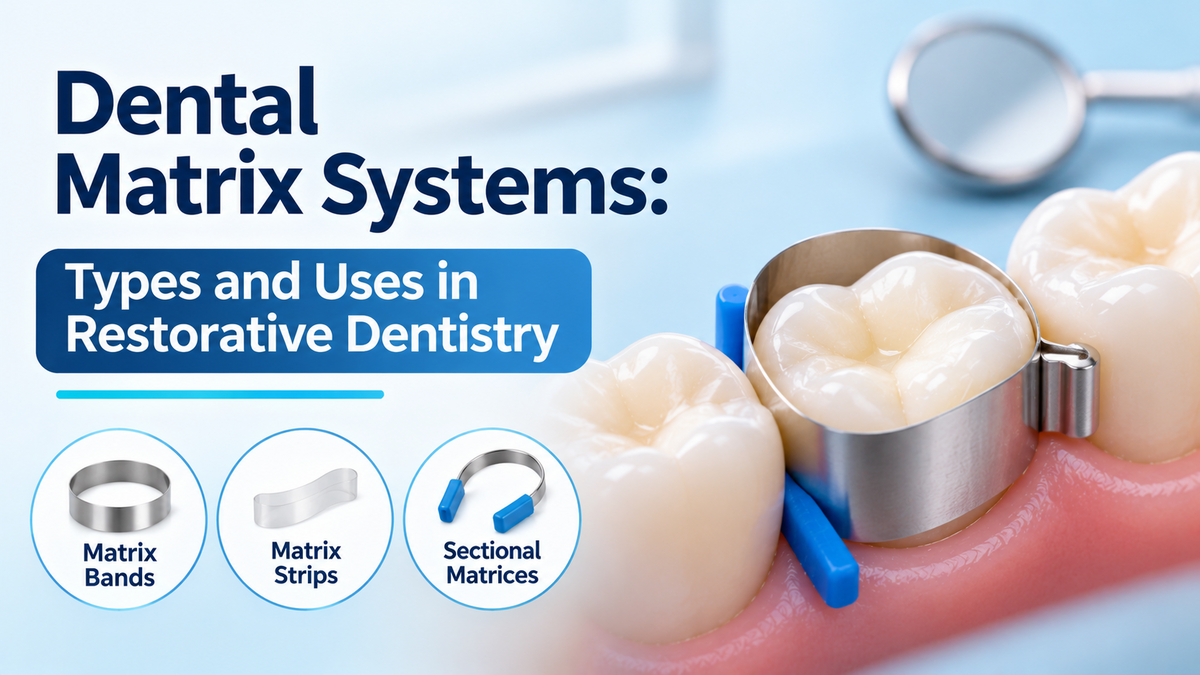
Rebuilding a damaged tooth involves more than placing restorative material into a prepared cavity. The clinician must recreate the tooth's natural contours, establish proper contact with adjacent teeth, and create margins that are easy to finish and maintain. Dental matrix systems help achieve these goals by temporarily replacing a missing tooth wall during restorative procedures.
From traditional metal matrix bands to modern pre-contoured systems and thermoplastic matrix materials, different designs support different clinical situations. Selecting the appropriate system can make restoration placement more controlled and help reduce problems such as open contacts, excess restorative material, and poorly shaped proximal surfaces.
For dental practices, understanding matrix system types is particularly important when performing Class II composite restorations, preparing temporary restorations, or managing complex tooth preparations.
This guide explains the major types of dental matrix systems, how they work, what to consider when selecting them, and how Premier Pre-Contoured Metal Bands and All Dental Temp Tabs Matrix Wafers fit into restorative workflows.
What Is a Dental Matrix System?
A dental matrix system is a temporary device or material used to provide form and support while a tooth is being restored. It creates a boundary against which restorative material can be placed and shaped.
When a cavity involves a proximal surface—the side of a tooth facing an adjacent tooth—the natural wall may be missing. Without a matrix, it can be difficult to control the restorative material and recreate the original tooth contour.
A matrix system can help clinicians:
Reconstruct missing proximal walls.
Establish appropriate interproximal contacts.
Reproduce the natural contour of a tooth.
Limit excess restorative material at the margins.
Shape restorative material during placement and setting.
Protect adjacent surfaces from unwanted restorative material.
The matrix does not work independently. Wedges, retainers, separation rings, and careful placement technique may also be needed, depending on the system and procedure.
Why Matrix Selection Matters in Restorative Dentistry
The shape of a restoration influences more than its appearance. A poorly formed proximal contact can allow food to become trapped between teeth, while excess material at the gingival margin can complicate finishing and hygiene.
An excessively flat proximal surface may also fail to reproduce the natural emergence profile of the tooth. The result can be a restoration that requires additional adjustment or does not provide the intended contact and contour.
Matrix systems help address these challenges, but their performance depends on the tooth's anatomy, the preparation, the restorative material, and the clinician's technique.
For example, a sectional matrix may be appropriate for a single proximal box in a posterior composite restoration, while a circumferential band may provide useful support for a larger preparation involving multiple surfaces.
The objective is not simply to contain the filling material. It is to create a restoration that follows the tooth's anatomy and functions appropriately.
Types of Dental Matrix Systems
1. Circumferential Metal Matrix Systems
Circumferential matrix systems wrap around the tooth and provide a temporary external wall. A conventional Tofflemire system uses a metal band held by a retainer that allows the clinician to adjust the band's circumference and position.
These systems have a long history in restorative dentistry and remain useful for a range of posterior procedures.
Common applications include:
Selected Class II restorations.
Preparations involving multiple proximal surfaces.
Larger cavities requiring support around the tooth.
Procedures where a circumferential band is compatible with the restorative technique.
Metal bands can provide a stable boundary, but the final contact and contour depend on band shape, adaptation, wedging, and placement.
A flat band may not naturally reproduce the convex proximal anatomy of a tooth. Clinicians may need to contour or burnish the band appropriately, depending on the material and technique.
2. Sectional Matrix Systems
Sectional matrix systems use a smaller band that covers the proximal area being restored rather than encircling the entire tooth.
Many systems combine three components:
A pre-contoured sectional band.
An interproximal wedge.
A separation ring.
The band establishes the proximal contour. The wedge helps adapt the band near the gingival margin, while the ring can provide separation and help stabilize the system.
Sectional matrices are commonly used for posterior Class II composite restorations, particularly when creating an anatomical contact with an adjacent tooth is a priority.
Their effectiveness depends on selecting an appropriate band shape and size and ensuring that the band fits the preparation without gaps or distortion.
3. Pre-Contoured Metal Matrix Bands
Pre-contoured matrix bands are shaped to approximate natural tooth anatomy. Their curvature can help reproduce the convex proximal surface more easily than a completely flat band.
They are available in different designs, thicknesses, and configurations. The appropriate option depends on the tooth, preparation size, desired contour, and matrix system being used.
Pre-contoured bands can be especially useful when a restoration requires an anatomical proximal wall and the selected technique benefits from a shaped metal boundary.
One example is the Premier Pre-Contoured Metal Bands, 0.035 mm, 30 per package, available from Sky Dental Supply.
The product is designed with an anatomical shape to support contact formation and is described by the manufacturer as suitable for large Class II restorations using an incremental curing technique. It has finished edges intended to improve patient comfort.
Product details:
Manufacturer: Premier Dental
Product: Pre-Contoured Metal Bands
Thickness: 0.035 mm
Package: 30 bands
Manufacturer part number: 9061070
These bands may be worth considering for practices that need pre-shaped metal matrix bands for appropriate posterior restorative procedures.
View the product: Premier Pre-Contoured Metal Bands.
4. Transparent Matrix Strips
Transparent matrix strips are commonly used for selected anterior restorations, including Class III and Class IV composite procedures.
Because they allow light to pass through, they can support light-curing procedures when used according to the restorative material's instructions.
These strips are useful when the clinician needs to shape a proximal surface while maintaining visibility of the restoration.
Their flexibility also makes them adaptable to different anterior tooth contours. However, they require careful stabilization to avoid creating an incorrect contour or leaving excess material at the gingival margin.
5. Retainerless Matrix Systems
Retainerless systems use a band that tightens around the tooth without a conventional external matrix holder.
They can be useful when a traditional retainer would interfere with access or when the clinician wants a more compact arrangement around the preparation.
The system must still be sized and positioned correctly. Adequate adaptation at the margins and sufficient stability during restorative placement remain essential.
6. Thermoplastic Matrix Materials
Thermoplastic matrix materials can be softened and shaped to suit a specific clinical situation. Depending on the product, these materials may be used for temporary matrices, bite registration, provisional procedures, or other applications described by the manufacturer.
They differ from conventional metal matrix bands because their flexibility and shape can be adjusted through controlled heating and manipulation.
One example is Temp Tabs Matrix Wafers in Blue, available from All Dental ProdX through Sky Dental Supply. These thermoplastic tabs are designed for several chairside applications, including temporary matrices, quick bite registration, temporary night guards, and selected implant-related procedures.
Their versatility makes them relevant to practices that perform both restorative and temporary procedures.
View the product: Temp Tabs Matrix Wafers, Blue, 72 per Box.
Understanding the Role of Wedges and Separation Rings
A matrix band alone may not provide the adaptation and separation needed for every restoration.
Dental Wedges
Wedges are placed interproximally to help adapt the matrix near the gingival margin. They can also create slight separation between adjacent teeth, helping compensate for matrix thickness and support the formation of a suitable contact.
Wedges come in different shapes and materials. Selection depends on the embrasure, gingival anatomy, access, and matrix design.
A poorly fitted wedge can leave a gap at the gingival margin or displace the matrix from its intended position. The clinician should confirm that the band remains properly adapted after wedging.
Separation Rings
Separation rings are used with many sectional matrix systems. Their spring action can separate adjacent teeth slightly and stabilize the band.
This separation may help compensate for the thickness of the matrix and support the creation of a tighter proximal contact after the restoration is completed.
Rings must be positioned correctly and checked for stability. They are not required for every matrix technique, and their suitability depends on the system and clinical situation.
How to Choose a Dental Matrix System
The most suitable matrix depends on the restoration rather than the product category alone.
Clinical situation | Matrix type to consider | Main selection factor |
Single-box posterior Class II composite | Sectional matrix with wedge and ring | Anatomical proximal contour and contact |
Larger or multi-surface posterior preparation | Suitable circumferential or other supported matrix | Stability and coverage |
Anterior proximal composite restoration | Transparent matrix strip | Visibility and esthetic contour |
Selected large Class II restoration | Pre-contoured metal band | Anatomical shape and controlled restorative placement |
Temporary matrix or selected provisional procedure | Appropriate thermoplastic matrix material | Adaptability and intended use |
Procedure requiring compact access around the tooth | Suitable retainerless system | Access and secure adaptation |
This table provides general guidance, not a universal clinical protocol. The manufacturer's instructions and the details of the preparation should determine the final selection.
Product Spotlight: Premier Pre-Contoured Metal Bands
The Premier Pre-Contoured Metal Bands listed by Sky Dental Supply offer an option for clinicians who prefer an anatomically shaped metal band for suitable restorative procedures.
Their 0.035 mm thickness and pre-contoured design are intended to support the recreation of proximal anatomy. The manufacturer's information specifically identifies large Class II restorations using incremental curing as an intended application.
Before selecting these bands, consider:
Whether the band shape suits the prepared tooth.
Whether the matrix can be adapted closely to the gingival margin.
Whether the selected retainer or supporting system is compatible.
Whether the band provides sufficient stability for the chosen restorative technique.
Whether the procedure requires a sectional rather than circumferential approach.
For practices performing regular posterior restorations, keeping appropriate matrix band sizes and designs available can help support an efficient restorative workflow.
Explore the product: Pre-Contoured Metal Bands by Premier Dental.
Product Spotlight: Temp Tabs Matrix Wafers by All Dental
Temp Tabs Matrix Wafers are blue thermoplastic tabs supplied in a package of 72. Sky Dental Supply lists the product under SKU A56100 and manufacturer part number 143020. The listed price at the time of review was $58.99, although pricing can change.
The manufacturer describes several applications:
Temporary matrix formation.
Quick bite registration.
Stabilization of three-way trays.
Selected implant placement guides and abutment jigs.
Temporary night guards and space-maintaining applications.
The product information specifies an approximately 20-second setup when used with an air syringe, light-curing through the tabs, and the ability to adjust flexibility by controlling thickness. The manufacturer also describes trimming with a heated scalpel or slow-speed instrument. These details should be followed only in accordance with the product's current instructions and the intended procedure.
When Are Temp Tabs Worth Considering?
Temp Tabs may be useful when a clinician needs an adaptable thermoplastic material for one of its indicated temporary or auxiliary applications.
They should not automatically replace conventional sectional or circumferential matrix bands for routine Class II restorations. The product's intended application, material properties, and handling instructions should guide its use.
Explore the product: Temp Tabs Matrix Wafers, Blue, 72 per Box.
Common Matrix Placement Errors and How to Avoid Them
Even a well-designed matrix can produce an unsatisfactory result if it is positioned incorrectly.
Poor Gingival Adaptation
A gap between the matrix and the gingival margin can allow restorative material to extend beyond the intended tooth contour.
What to check: Inspect the cervical margin before placing the restorative material. Adjust the band or wedge until the matrix is adequately adapted.
Incorrect Proximal Contact
An open contact can contribute to food impaction, while an excessively tight or poorly positioned contact may make cleaning difficult.
What to check: Consider the band contour, wedge placement, tooth separation, and restoration technique. After removing the matrix, assess the contact and contour clinically.
Band Distortion
A band that bends or shifts during placement can produce an incorrect proximal surface.
What to check: Confirm that the band is stable before placing the restorative material. Avoid excessive force that could deform the matrix.
Excess Restorative Material
Material extending beyond the intended margins can complicate finishing and may affect gingival health.
What to check: Ensure that the matrix fits closely around the preparation and use an appropriate placement technique for the selected restorative material.
Choosing the Wrong Matrix for the Procedure
A system that works well for one cavity design may be unsuitable for another.
What to check: Match the matrix to the preparation's size, location, proximal anatomy, and restorative material rather than relying on a single system for every case.
Cleaning, Handling, and Inventory Management
Matrix components should be handled according to their product-specific instructions.
Reusable retainers and rings must be cleaned, inspected, and sterilized using the manufacturer's validated procedure. Single-use bands and disposable components should be discarded according to their labeling and applicable infection-control requirements.
Before use, inspect reusable components for damage, deformation, or loss of function. A bent band or weakened ring may not provide the expected stability.
Dental practices should also keep commonly used matrix designs organized by type and size. Separating pre-contoured bands, transparent strips, wedges, rings, and temporary matrix materials can help staff locate the correct product without unnecessary delays.
For products with several possible applications, such as Temp Tabs, staff should be familiar with the intended uses and instructions so that the material is selected appropriately.
FAQs About Dental Matrix Systems
What is the purpose of a dental matrix system?
A matrix system temporarily replaces a missing tooth wall during restorative treatment. It helps shape the restoration, establish proximal contacts, and control restorative material at the margins.
What is the difference between a sectional and circumferential matrix?
A sectional matrix covers the proximal area being restored, while a circumferential matrix wraps around the tooth. Sectional systems are often considered for single-box posterior composite restorations, while circumferential systems can provide useful coverage for larger preparations.
Why use pre-contoured metal matrix bands?
Pre-contoured bands have an anatomical shape designed to help recreate natural proximal contours. Their suitability depends on the preparation and the matrix technique.
What are Premier Pre-Contoured Metal Bands used for?
The Premier bands listed by Sky Dental Supply are 0.035 mm thick and supplied in a package of 30. Manufacturer information identifies them as suitable for large Class II restorations using incremental curing techniques.
What are Temp Tabs Matrix Wafers?
Temp Tabs are thermoplastic tabs designed for multiple indicated chairside applications, including temporary matrices and quick bite registration. They are not automatically interchangeable with conventional matrix bands.
Are wedges necessary with every matrix system?
No. Wedges are commonly used with sectional and circumferential matrix techniques to improve adaptation and help manage proximal contact. The requirement depends on the system and procedure.
How do you prevent overhangs when using a matrix band?
Careful band adaptation, suitable wedging, stable positioning, and controlled restorative placement can help reduce the risk of excess material at the margins. The finished restoration should be inspected and adjusted as necessary.
Final Thoughts
Dental matrix systems are essential tools for recreating tooth anatomy during many restorative procedures. The correct system helps the clinician manage proximal contour, contact formation, and marginal adaptation while placing restorative material.
Sectional matrices, circumferential bands, transparent strips, pre-contoured metal bands, and thermoplastic matrix materials each have different strengths. Their value depends on choosing a design that suits the tooth, preparation, and intended procedure.
Sky Dental Supply offers options for different restorative workflows, including Premier Pre-Contoured Metal Bands for suitable posterior restorations and All Dental Temp Tabs Matrix Wafers for their specified temporary and auxiliary applications.
A thoughtful selection process, accurate placement, and appropriate handling help dental professionals achieve more predictable restorative contours and maintain an efficient clinical workflow.