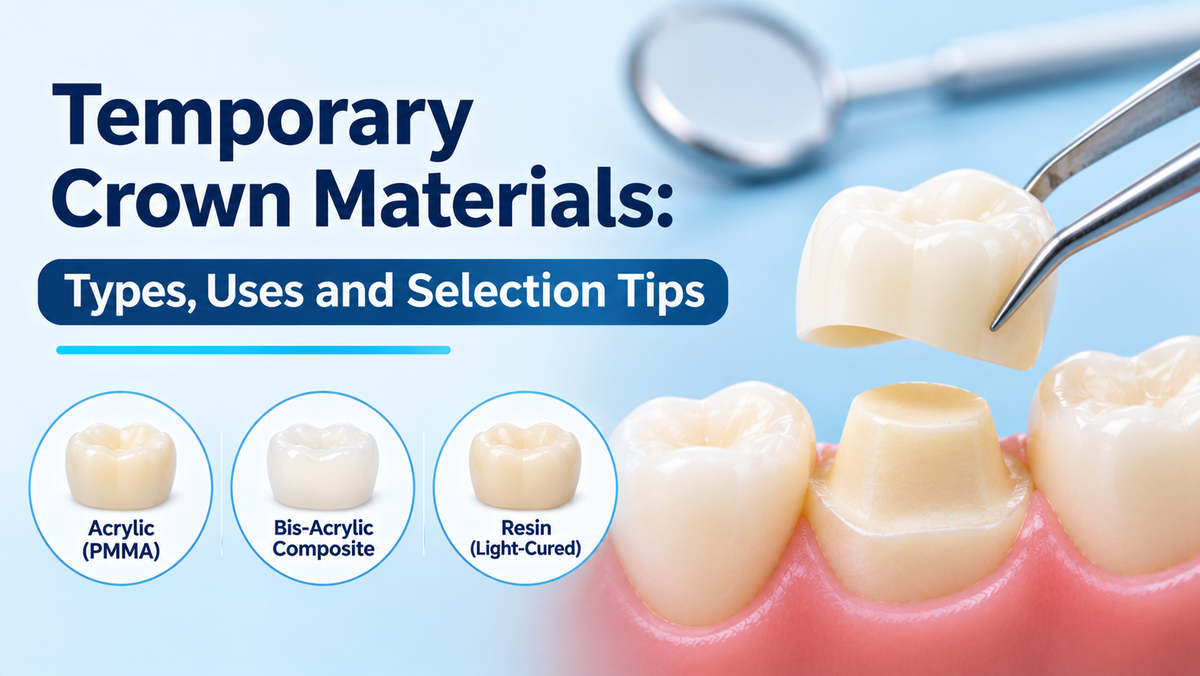
A temporary crown is more than a short-term covering placed while a permanent restoration is being fabricated. It helps protect the prepared tooth, maintain function, preserve the position of neighboring teeth, and support gingival health during the restorative process. For patients receiving crowns, bridges, veneers, or other indirect restorations, the quality of the provisional restoration can influence comfort, appearance, and the overall treatment experience.
For dental professionals, selecting the right temporary crown material means balancing several factors: strength, marginal fit, polishability, shade, setting time, ease of removal, and the length of time the restoration must remain in place. A material suitable for a single posterior crown may not be the best option for a long-span provisional bridge or an anterior restoration where aesthetics are especially important.
Modern temporary crown and bridge materials include bis-acryl composites, polymethyl methacrylate (PMMA), other acrylic resins, and prefabricated temporary crowns. Each option has different handling characteristics and clinical applications.
This guide explores the main types of temporary crown materials, explains how clinicians can compare their properties, and highlights relevant products available from Sky Dental Supply, including TEMPSMART, Perfectemp II, and Protemp Crown.
Why Temporary Crown Materials Matter
After a tooth is prepared for a definitive crown, the exposed tooth structure may be sensitive to temperature, pressure, and oral conditions. A provisional restoration helps protect the prepared tooth while the final crown or bridge is being manufactured or treatment is being completed.
A well-designed temporary restoration can provide several benefits:
Protection of prepared tooth structure: Covering the preparation helps reduce sensitivity and protects exposed dentin from external stimuli.
Maintenance of tooth position: A properly fitted provisional helps limit unwanted movement of the prepared tooth or adjacent teeth during the temporary phase.
Gingival management: Appropriate contours and margins support tissue health and make it easier for patients to maintain oral hygiene around the restoration.
Functional support: Temporary crowns and bridges can help maintain occlusal relationships and allow patients to function while waiting for the definitive restoration.
Aesthetic continuity: Tooth-colored materials can help maintain a natural-looking smile, particularly when anterior teeth are involved.
Evaluation of the planned restoration: In selected cases, provisional restorations allow clinicians to assess contours, phonetics, aesthetics, and patient comfort before finalizing the definitive prosthesis.
The temporary material alone does not guarantee these outcomes. Preparation design, marginal accuracy, occlusion, cementation, finishing, and patient instructions also play important roles.
The Main Types of Temporary Crown Materials
Temporary crown materials differ in composition, delivery method, curing behavior, and mechanical performance. Understanding these differences makes it easier to match the material to the clinical situation.
1. Bis-Acryl Composite Materials
Bis-acryl composite materials are widely used for chairside fabrication of provisional crowns and bridges. They are commonly supplied in dual-barrel cartridges with automix tips, allowing the components to be dispensed and mixed during application.
These materials are often selected because they offer a useful combination of strength, aesthetics, and finishing characteristics.
Typical advantages include:
Convenient cartridge dispensing and consistent mixing.
Tooth-like shades for aesthetic provisional restorations.
Good polishability with suitable finishing procedures.
Mechanical properties appropriate for many single-unit and multi-unit provisional restorations.
Availability in formulations designed for different working and setting times.
Bis-acryl products may be used to fabricate temporary crowns, bridges, inlays, onlays, and veneers when indicated by the manufacturer. Some formulations are also designed for longer-term provisional use.
However, not all bis-acryl products have identical properties. Clinicians should compare the manufacturer's instructions for working time, intraoral removal time, final setting, repairability, and intended indications.
Product to consider: TEMPSMART Temporary Crown and Bridge Material from GC America is a dual-cured bis-acryl composite that uses micro-filled resin and nano-filler technologies. The manufacturer describes it as suitable for temporary crowns, bridges, inlays, onlays, veneers, and long-term temporary restorations. Its listed features include fracture toughness, flexural strength, and gloss retention after polishing.
2. Polymethyl Methacrylate (PMMA)
PMMA is an acrylic resin used in a variety of dental provisional applications. Depending on the product and fabrication technique, it may be processed in the dental laboratory or used in other workflows specified by the manufacturer.
PMMA has a long history in dentistry and can be useful when a provisional restoration requires customized contours or a particular fabrication approach.
Potential benefits include:
Established fabrication techniques.
Good aesthetic potential after finishing and polishing.
Suitability for selected long-span or extended provisional applications when the formulation and design support them.
Options for customization and repair, depending on the product.
PMMA also has limitations. Polymerization shrinkage, heat generation during setting, odor, and handling requirements can be relevant depending on the formulation and method of use. The material may require additional finishing and polishing to achieve the desired surface quality and marginal form.
Clinicians should distinguish between laboratory-processed PMMA and chairside acrylic systems rather than assuming that all acrylic materials behave the same way.
3. Other Acrylic Resin Materials
Temporary restorations may also be fabricated using other acrylic resin formulations, including self-curing materials. These products can offer practical solutions for selected provisional procedures.
Their performance depends on the resin chemistry, mixing ratio, polymerization process, restoration design, and finishing technique.
When comparing acrylic-based materials with bis-acryl composites, consider:
The time available for fabrication.
The required strength and expected service period.
The ease of trimming and polishing.
Potential heat generation during polymerization.
The accuracy of the impression or matrix used.
The ability to repair the provisional if it becomes damaged.
Acrylic materials remain useful in many restorative workflows, but clinicians should select a product based on its intended application rather than on the material category alone.
4. Prefabricated Temporary Crowns
Prefabricated temporary crowns offer an alternative to fabricating every provisional from a mold or impression. They are available in different tooth types and sizes and can be selected, trimmed, and adapted to the prepared tooth according to the manufacturer's instructions.
These products can be particularly useful when a single-unit provisional is needed quickly and the clinician wants to reduce the number of fabrication steps.
Depending on the product, advantages may include:
No impression or matrix required for the basic fabrication process.
Reduced need for mixing materials.
Convenient size selection.
A straightforward trimming and adaptation workflow.
Potential time savings for suitable single-unit cases.
The trade-off is that prefabricated crowns require appropriate size selection and careful adaptation. They may need contouring, adjustment, and finishing to achieve suitable margins, proximal contacts, and occlusion.
Product to consider: Protemp Crown Temporization Material from Solventum (3M) is a preformed, malleable, light-curable composite temporary crown. The Sky Dental Supply listing describes a system designed to be trimmed and adapted using common dental instruments, without requiring an impression or matrix for its basic application. The listing includes crown-size options for different tooth types, with packages varying by selection.
5. Preformed Metal and Other Temporary Crown Options
Preformed metal crowns may be considered for particular clinical situations, including certain posterior provisional or pediatric applications, depending on the treatment plan and product indications. Other preformed options may be available for specific uses.
These products are not interchangeable with tooth-colored composite provisionals. Their appearance, adaptation requirements, intended patient populations, and clinical indications differ.
For adult aesthetic cases, clinicians commonly prioritize tooth-colored options. For other situations, the appropriate choice depends on the purpose of the restoration and the manufacturer's instructions.
How to Select a Temporary Crown Material for Different Clinical Needs
The best material is the one that meets the clinical requirements of the case without introducing unnecessary complexity.
Anterior Crowns: Prioritize Aesthetics and Surface Finish
When a temporary crown is placed on an anterior tooth, shade, translucency, contour, and polish become particularly important. The provisional may be visible during speech and smiling, so the material should support an acceptable appearance throughout the temporary period.
Consider a material that offers suitable tooth shades and a smooth finish after polishing. The clinician should also evaluate the emergence profile and gingival contours, since an attractive shade cannot compensate for an overcontoured or poorly fitting provisional.
Posterior Crowns: Consider Functional Demands
Posterior teeth experience substantial chewing forces. A temporary crown in this region needs appropriate strength, sufficient thickness, and a design that distributes loading without creating excessive stress.
For patients with heavy occlusion or parafunctional habits, the clinician may need to consider additional precautions. The material's published mechanical properties are relevant, but the provisional's geometry, occlusion, and remaining tooth structure also influence performance.
Multi-Unit Bridges: Evaluate Strength and Connector Design
A multi-unit provisional bridge places different demands on the material than a single crown. Connector dimensions, span length, occlusal loading, and the quality of the supporting preparations all affect the risk of fracture.
A material specifically indicated for multi-unit provisional restorations may be preferable to one intended primarily for single-unit applications. TEMPSMART, for example, is described by its manufacturer as having high flexural strength suitable for multi-unit temporization.
The clinician should still assess whether the selected material and design are appropriate for the planned span and expected duration.
Longer Provisional Periods: Focus on Durability and Maintenance
Some patients require a temporary restoration for longer than expected because of staged treatment, laboratory delays, tissue management, or other clinical circumstances.
For an extended provisional period, consider wear resistance, fracture resistance, repair options, color stability, and the patient's ability to maintain oral hygiene. A material intended for longer-term provisional use may be appropriate, but no temporary restoration should be assumed to perform indefinitely.
Regular review and timely replacement when indicated remain important.
Fast Chairside Procedures: Consider Delivery and Setting Time
When chairside efficiency is important, cartridge-based materials and prefabricated crowns can simplify parts of the workflow.
Automix systems help dispense and mix materials in a controlled manner, while preformed crowns can reduce the need for impression-based fabrication. However, clinicians should distinguish between working time, intraoral removal time, and final setting time.
Removing a material too early or continuing to manipulate it beyond its recommended working time can compromise the result. Always follow the product's instructions rather than relying on a general timing rule.
Product Spotlight: TEMPSMART Temporary Crown and Bridge Material
TEMPSMART from GC America is a dual-cured bis-acryl composite designed for temporary crown and bridge fabrication. Its micro-filled resin and nano-filler technologies are intended to support surface smoothness, polishability, and mechanical performance.
Sky Dental Supply lists the 48 mL cartridge with 16 mixing tips. Listed shade options include A1, A2, A3, A3.5, B1, and bleach white, subject to the selected variant and current availability.
Why clinicians may consider TEMPSMART
Dual-cure formulation: Supports the product's specified curing process.
Polishability: Designed to maintain a smooth surface after finishing.
Fracture toughness: Relevant when evaluating provisional durability.
Flexural strength: A consideration for appropriate multi-unit provisionals.
Multiple shade options: Helpful when matching the provisional to the patient's appearance.
TEMPSMART may be worth evaluating for cases requiring an aesthetic provisional and for selected multi-unit applications. The clinician should verify the exact package, shade, and indications before ordering.
View the TEMPSMART product listing at Sky Dental Supply.
Product Spotlight: Perfectemp II Temporary Crown and Bridge Material
Perfectemp II from DenMat is a self-curing bis-acrylic temporary crown and bridge material. Sky Dental Supply lists a 50 mL cartridge package with 15 mixing tips.
The product information highlights strength, wear resistance, shade selection, and the ability to trim and polish the provisional. It is described as suitable for temporary crowns and bridges, including selected multi-unit provisional restorations.
Features to review
Self-curing formulation: Designed to set according to the manufacturer's specified protocol.
Automix delivery: The listed cartridge system supports convenient dispensing.
Shade options: The available shades help clinicians select a suitable appearance.
Finishing characteristics: The material is designed to support trimming and polishing.
Provisional applications: Its indications should be reviewed for the planned single-unit or multi-unit case.
Perfectemp II may be a useful option when a self-curing bis-acryl system fits the clinician's preferred workflow. Before use, confirm the recommended working time, intraoral removal time, final set, and package instructions.
Explore Perfectemp II Temporary Crown and Bridge Material.
Product Spotlight: Protemp Crown Temporization Material
Protemp Crown from Solventum (3M) is a preformed, light-curable composite temporary crown system. Instead of forming the provisional from an impression and a cartridge material, the clinician selects a suitable crown size and adapts it to the prepared tooth.
The Sky Dental Supply product listing describes packages that include five temporary crowns, instructions, and a crown-size tool, with variations for different tooth types and sizes.
When the format may be useful
A single-unit temporary crown is required.
A chairside workflow without an impression or matrix is preferred.
The clinician wants to select from predefined crown sizes.
Trimming and adaptation with common dental instruments fit the planned procedure.
The preformed format may reduce certain fabrication steps, but it does not remove the need to verify fit, margins, proximal contacts, occlusion, and retention. The selected crown must be adapted appropriately and used according to the manufacturer's instructions.
View Protemp Crown Temporization Material.
A Clinical Checklist Before You Place the Provisional
Before finalizing a temporary crown or bridge, evaluate the restoration as a complete unit rather than focusing only on the material.
Marginal fit: Confirm that the margins are acceptable and that the provisional does not leave exposed prepared tooth structure or create an overhang.
Proximal contacts: Check contact with neighboring teeth. Open contacts may allow food impaction or unwanted tooth movement, while overly tight contacts can make seating and cleaning difficult.
Occlusion: Evaluate static and dynamic contacts as appropriate. Premature or excessive contacts can contribute to discomfort or provisional fracture.
Contour and tissue response: Avoid contours that place unnecessary pressure on the gingiva or make cleaning difficult.
Surface finish: Trim and polish the provisional as directed. A rough surface can collect plaque and compromise comfort.
Retention and cementation: Select a temporary cement appropriate for the provisional material and planned definitive cementation. Follow the cement manufacturer's instructions and avoid excess cement around the gingival margins.
Patient instructions: Explain how to care for the provisional, what foods or habits may increase the risk of displacement or fracture, and when to contact the practice.
Common Mistakes When Choosing Temporary Crown Materials
Selecting by Price Alone
The lowest-cost material may not be the most suitable for every procedure. A multi-unit bridge, a highly visible anterior provisional, and a short-term single posterior crown have different requirements. Compare material performance and workflow alongside purchase cost.
Ignoring the Expected Duration
A provisional intended for a short interval may not be suitable for a longer treatment plan. When treatment is likely to extend, consider durability, wear, repairability, and the need for follow-up.
Assuming All Bis-Acryl Materials Perform the Same Way
Products can differ in formulation, strength, curing behavior, shade availability, and working time. Review the specific manufacturer's information before selecting a material.
Overlooking Finishing and Occlusion
Even a material with favorable mechanical properties can fail if the provisional is too thin, poorly contoured, inadequately finished, or exposed to excessive occlusal loading.
Choosing a Prefabricated Crown Without Adequate Adaptation
A preformed crown can streamline fabrication, but size selection is only the starting point. The clinician still needs to verify seating, margins, contacts, contours, and occlusion.
Frequently Asked Questions
1. What is the most commonly used material for temporary crowns?
Bis-acryl composite materials are commonly used for chairside temporary crowns because they combine convenient dispensing, aesthetic options, and useful mechanical properties. Acrylic resins and prefabricated crowns also have important roles depending on the case.
2. What is the difference between bis-acryl and PMMA temporary crown materials?
Bis-acryl materials are commonly supplied in automix cartridges and are used for chairside provisional fabrication. PMMA is an acrylic resin used in several fabrication workflows, including laboratory processing. Their handling, polymerization, finishing, and mechanical properties vary by product.
3. Which temporary crown material is suitable for a bridge?
The choice depends on the bridge span, connector design, occlusal forces, expected duration, and manufacturer indications. A material specifically indicated for multi-unit provisionals should be evaluated when fabricating a temporary bridge.
4. Can temporary crown materials be used for long-term provisional restorations?
Some products are designed for longer-term provisional use. Suitability depends on the product instructions, restoration design, oral conditions, and treatment plan. Long-term use requires appropriate monitoring and maintenance.
5. Are prefabricated temporary crowns easier to use?
Prefabricated systems can reduce the need for an impression or matrix and may simplify certain single-unit procedures. They still require correct size selection, trimming, adaptation, finishing, and occlusal assessment.
6. How should clinicians choose between TEMPSMART, Perfectemp II, and Protemp Crown?
TEMPSMART is a dual-cured bis-acryl material, Perfectemp II is a self-curing bis-acryl material, and Protemp Crown is a preformed light-curable composite crown system. Compare the clinical indication, fabrication method, curing protocol, expected duration, aesthetics, and available package options before choosing.
Final Thoughts
Temporary crown materials play an important role in protecting prepared teeth and maintaining function and appearance before definitive restorations are placed. The best choice depends on the restoration's design, the expected duration, aesthetic requirements, mechanical demands, and the clinician's preferred workflow.
Bis-acryl composites such as TEMPSMART and Perfectemp II provide options for fabricating provisional crowns and bridges. PMMA and other acrylic resins remain useful in selected workflows, while prefabricated systems such as Protemp Crown can simplify appropriate single-unit procedures.
Sky Dental Supply offers a range of temporary crown and bridge products to help dental practices compare options for different restorative needs. Review the product's current instructions, intended indications, available shades, package contents, and compatibility before ordering. A well-selected material, combined with accurate adaptation and careful clinical evaluation, helps support a functional and comfortable provisional restoration.