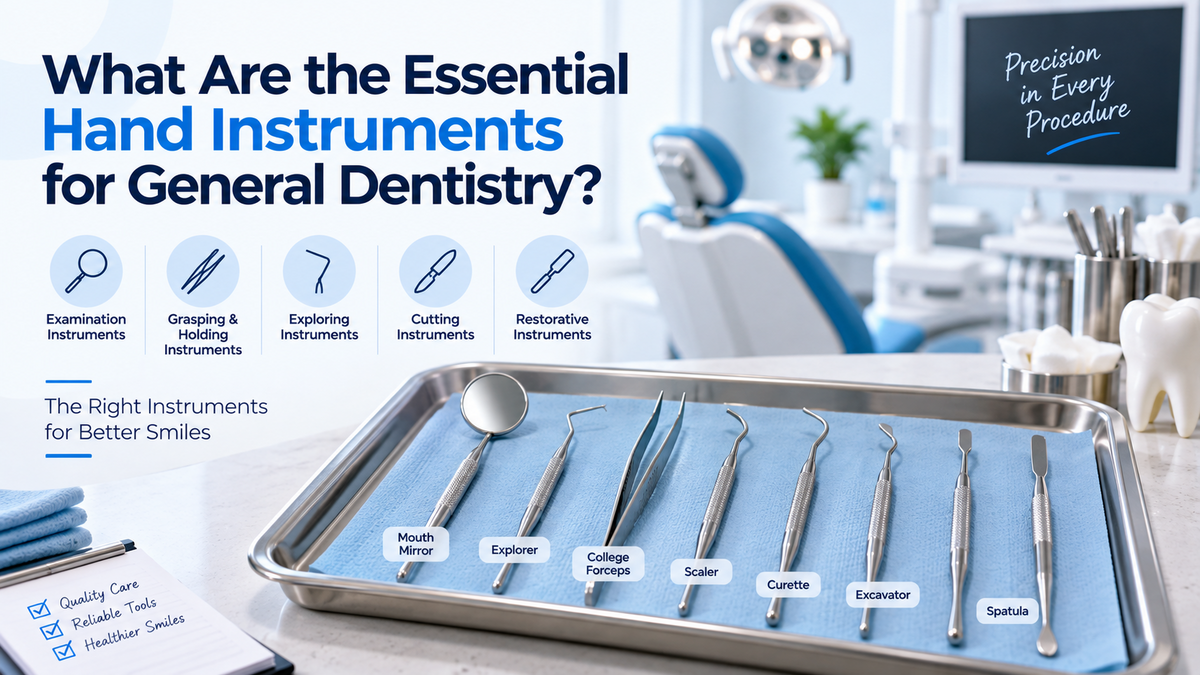
A well-equipped dental practice depends on having the right instruments available for routine examinations, preventive care, restorative procedures, and minor clinical treatments. While modern dentistry includes advanced imaging systems, digital scanners, electric handpieces, and other technology, traditional hand instruments remain essential to everyday patient care.
Dental hand instruments are designed for specific tasks such as examining teeth, removing deposits, preparing tooth surfaces, placing restorative materials, and maintaining oral hygiene. Choosing instruments that are durable, comfortable to hold, easy to clean, and appropriate for the procedure can make clinical work more efficient and precise.
For dentists setting up a new operatory or replacing older instruments, understanding the most important categories is a practical first step. This guide explains the essential hand instruments commonly used in general dentistry and how they fit into everyday clinical procedures.
What Are Dental Hand Instruments?
Dental hand instruments are manually operated tools used by dentists and dental professionals during examination, diagnosis, prevention, restoration, and other oral procedures. Unlike powered equipment such as ultrasonic scalers or dental handpieces, these instruments are primarily controlled by the clinician's hand.
Common examples include mouth mirrors, explorers, periodontal probes, excavators, scalers, curettes, condensers, composite instruments, and dental forceps.
Although each instrument has a specific purpose, many are designed to provide tactile feedback. This allows clinicians to feel changes in tooth surfaces, deposits, tissue, or restorative materials while working.
A properly selected instrument set can therefore support both efficiency and clinical control.
1. Mouth Mirrors
A mouth mirror is one of the most basic and frequently used instruments in general dentistry.
It consists of a small reflective mirror attached to a handle. The mirror helps the dentist view areas of the mouth that are difficult to see directly. It can also be used to gently retract the cheek, tongue, or soft tissue and provide indirect illumination.
Mouth mirrors are useful during:
Routine dental examinations
Caries assessment
Restorative procedures
Oral hygiene evaluation
Periodontal examinations
Dental photography and visualization
Different mirror sizes, handle designs, and configurations are available, allowing clinicians to select options according to their preferences and procedure requirements.
2. Dental Explorers
Dental explorers are precision instruments used primarily for tactile examination of tooth surfaces.
An explorer has a thin working end that allows the clinician to examine grooves, pits, margins, and other areas of the tooth. Explorers can assist with identifying irregularities and evaluating areas that may require further diagnostic attention.
Endodontic explorers are another specialized type. Sky Dental Supply notes that its dental instrument selection includes explorers with thin, flexible, tapered tips, available in single- and double-ended designs.
The correct use of an explorer should always follow current clinical guidance and diagnostic protocols rather than relying on tactile findings alone.
3. Periodontal Probes
Periodontal probes are essential for evaluating the health of the tissues surrounding teeth.
They are marked with measurement graduations and are commonly used to assess periodontal pocket depths and other periodontal findings. Regular periodontal assessment helps dental professionals identify changes in gum health and monitor patients over time.
A periodontal probe should be easy to read, comfortable to handle, and suitable for the type of periodontal examination being performed.
For general dental practices, having periodontal probes readily available is important because periodontal assessment is a routine component of comprehensive oral examinations.
4. Dental Scalers
Scalers are hand instruments designed for removing deposits such as calculus from tooth surfaces.
They generally have pointed working ends and are commonly used during periodontal and hygiene procedures. Different scaler designs are available for specific tooth surfaces and clinical applications.
Dental professionals may choose instruments based on:
Working-end shape
Shank design
Handle diameter
Accessibility
Ergonomics
Procedure requirements
Because calculus removal requires controlled instrumentation, proper instrument selection and clinical technique are important.
5. Periodontal Curettes
Curettes are another important group of periodontal hand instruments.
Compared with traditional scalers, curettes generally have rounded tips and are designed for periodontal instrumentation. Different curette designs are available for various surfaces and areas of the mouth.
Universal curettes can be useful for a broad range of surfaces, while area-specific curettes are designed for particular tooth regions.
For dental hygiene procedures, curettes can help clinicians perform controlled subgingival and supragingival instrumentation according to the patient's needs.
Sky Dental Supply carries a broad selection of dental instruments, including hygiene tools such as scalers and curettes.
6. Dental Excavators
Excavators are commonly associated with restorative dentistry.
They are used for tasks such as removing softened dentin during certain cavity preparation techniques and assisting with the removal or manipulation of dental materials. Excavator designs vary according to the intended application.
A good excavator should provide:
A comfortable grip
Appropriate working-end shape
Adequate strength
Good tactile control
Proper balance
For practices performing a variety of restorative procedures, having several excavator designs available can be useful.
7. Composite Placement Instruments
Modern restorative dentistry frequently involves tooth-colored composite materials. Composite placement instruments help dentists carry, place, adapt, shape, and contour restorative material.
These instruments are available in numerous shapes and configurations. Some have specialized working ends designed for sculpting anatomy, adapting composite, or reaching difficult areas.
The right instrument can make it easier to achieve controlled placement while reducing unnecessary manipulation of the material.
8. Condensers and Pluggers
Condensers and pluggers are designed to compact or adapt restorative materials.
They are particularly useful when a material needs to be pressed into a prepared area or adapted against cavity walls. Working ends may be round, flat, or specially shaped depending on the intended application.
These instruments are valuable additions to a general restorative instrument setup because they provide manual control that cannot always be replaced by powered equipment.
9. Dental Carvers
Carvers are used to shape and contour restorative materials.
During restorative procedures, a dentist may need to recreate tooth anatomy, define grooves, remove excess material, or refine the contours of a restoration. A carver with the appropriate working end can help accomplish these tasks.
Different designs are intended for different shaping requirements, so practices may maintain several carver styles within their restorative instrument collection.
10. Dental Spatulas
Dental spatulas are useful for mixing, carrying, and manipulating certain dental materials.
Depending on the design, a spatula may be used for cement, impression-related materials, restorative materials, or laboratory procedures. Their usefulness makes them a practical component of a general dental instrument inventory.
When selecting a spatula, consider the material being handled, the working-end dimensions, and whether the instrument is intended for intraoral or laboratory use.
11. Dental Forceps
Dental forceps are specialized instruments primarily associated with tooth extraction procedures.
Different forceps designs correspond to different teeth and extraction approaches. Their beaks and overall shape are designed to provide appropriate access and controlled engagement.
Because forceps are procedure-specific, a general dental practice may maintain several configurations rather than relying on a single universal design.
Extraction instruments should be selected according to the dentist's clinical training, procedure requirements, and applicable infection-control protocols.
12. Dental Elevators
Elevators are commonly used during extraction procedures to assist with luxation and tooth removal.
They are available in different shapes and sizes, with designs intended for specific clinical situations. Straight elevators, root elevators, and other specialized designs may be included in an extraction setup.
As with forceps, elevators require appropriate training and technique. Their selection should be based on the tooth, surrounding anatomy, and planned extraction approach.
13. Endodontic Hand Instruments
General dental practices that perform root canal procedures may also need specialized endodontic hand instruments.
These can include:
Endodontic explorers
Hand files
Reamers
Spreaders
Pluggers
Endodontic excavators
Broaches
Sky Dental Supply's endodontic range includes K-files, H-files, reamers, spreaders, pluggers, and other root canal accessories.
These instruments are designed for different stages of canal preparation and obturation, so dentists should select them based on their preferred endodontic system and clinical technique.
Hand Instruments vs. Dental Handpieces
It is important to distinguish manual hand instruments from powered dental handpieces.
A dental handpiece is a powered device used with dental burs or other attachments for procedures requiring rotation. High-speed and low-speed handpieces serve different clinical purposes.
Sky Dental Supply's handpiece category includes high-speed, low-speed, electric, surgical, implant, and endodontic handpieces, along with couplers, turbine components, handpiece parts, and maintenance products.
For example, the company's selection includes options such as the AlphaAir Highspeed Handpiece PB 4-Hole and various electric handpiece systems.
Hand instruments and handpieces therefore complement each other. A general dentistry setup normally requires both manual instruments for examination and manipulation and powered equipment for procedures involving rotary instrumentation.
How to Choose the Right Dental Hand Instruments
Buying dental instruments is not simply about selecting the largest possible collection. A practice should focus on instruments that match its procedures and workflow.
Consider the Procedure
Start by identifying the procedures performed most frequently. A general practice may prioritize examination, hygiene, restorative, extraction, and preventive instruments.
Focus on Ergonomics
Instrument handles should feel comfortable during repeated use. Proper ergonomics can support clinician comfort and controlled instrumentation.
Look for Durable Construction
High-quality instruments are commonly manufactured from materials designed to withstand repeated clinical use and sterilization. Stainless steel is widely used for many dental instruments.
Maintain Instrument Sharpness
Scalers, curettes, and other cutting instruments need appropriate maintenance. A dull instrument can reduce efficiency and may require additional pressure during use.
Follow Sterilization Requirements
Reusable dental instruments must be cleaned, processed, packaged, and sterilized according to applicable infection-control procedures and manufacturer instructions.
Build a Procedure-Based Inventory
Instead of purchasing instruments randomly, organize your inventory around common procedures. This helps ensure that essential instruments are available when needed while reducing unnecessary purchases.
Why Instrument Quality Matters in General Dentistry
Dental instruments are handled repeatedly throughout the day. Their design can affect visibility, tactile feedback, precision, and clinician comfort.
A well-designed instrument should provide reliable control without unnecessarily increasing hand fatigue. Balanced handles and appropriate working-end designs can make routine procedures more manageable.
Quality also matters from a maintenance perspective. Instruments that are properly cared for can remain useful for a long time, helping practices manage replacement costs and maintain consistent workflows.
Why Consider Sky Dental Supply?
Sky Dental Supply offers a broad range of dental products for practices looking to source instruments, equipment, supplies, and related clinical products from one supplier.
Its dental instrument selection includes hygiene instruments, diagnostic instruments, explorers, mirrors, and other clinical tools. The company also provides a large selection of dental handpieces, with categories covering high-speed, low-speed, electric, surgical, implant, and endodontic applications.
This broad product range can be useful for practices that want to purchase routine instruments alongside larger equipment and specialized dental products.
When comparing products, dental professionals should review specifications, compatibility, intended use, manufacturer recommendations, maintenance requirements, and applicable regulatory or infection-control requirements before making a purchase.
Creating a Practical General Dentistry Instrument Setup
A basic general dentistry setup does not need to contain every instrument available. Instead, it should cover the procedures the practice performs regularly.
A practical collection may include:
Mouth mirrors for visualization
Explorers for tactile examination
Periodontal probes for periodontal assessment
Scalers and curettes for hygiene procedures
Excavators for restorative applications
Composite placement instruments
Condensers and pluggers
Carvers for restorative shaping
Spatulas for material handling
Forceps and elevators for extraction procedures
Endodontic instruments when root canal treatment is performed
Over time, practices can expand their inventory based on clinical demand and dentist preference.
Final Thoughts
Essential hand instruments remain at the center of general dentistry, even as dental technology continues to advance. From a simple mouth mirror and explorer to periodontal curettes, restorative instruments, forceps, elevators, and endodontic tools, each instrument has a specific role in clinical care.
The best approach is to build an instrument collection around the procedures performed in the practice, while prioritizing quality, ergonomics, durability, maintenance, and proper sterilization.
For practices looking to expand their equipment and instrument inventory, Sky Dental Supply's dental handpiece collection provides access to a wide selection of powered handpieces and related accessories, while its broader dental instrument range can support everyday clinical needs.
Frequently Asked Questions
1. What are the most essential hand instruments for a general dentist?
A basic collection commonly includes a mouth mirror, explorer, periodontal probe, scalers, curettes, excavators, restorative instruments, condensers, carvers, and appropriate extraction instruments. The exact selection depends on the procedures performed.
2. What is the purpose of a dental explorer?
A dental explorer is primarily used for tactile examination of tooth surfaces, grooves, margins, and other areas during clinical assessment. It should be used as part of a comprehensive diagnostic process.
3. Are periodontal probes necessary in general dentistry?
Yes. Periodontal probes are important for assessing periodontal tissues and measuring periodontal pocket depths during routine periodontal examinations.
4. What is the difference between a scaler and a curette?
Both can be used for dental calculus removal, but their working-end designs differ. Scalers generally have pointed tips, while curettes typically have rounded tips and are designed for periodontal instrumentation.
5. Does Sky Dental Supply sell dental instruments?
Yes. Sky Dental Supply offers a broad dental instrument selection, including hygiene and diagnostic instruments such as scalers, curettes, mirrors, and explorers.
6. Does Sky Dental Supply sell dental handpieces?
Yes. Its handpiece category includes high-speed, low-speed, electric, surgical, implant, and endodontic handpieces, along with related parts and accessories.
7. How should reusable dental hand instruments be maintained?
Reusable instruments should be cleaned, inspected, processed, sterilized, stored, and maintained according to the instrument manufacturer's instructions and applicable infection-control requirements.
8. How often should dental instruments be replaced?
There is no single replacement schedule for every instrument. Replacement depends on wear, corrosion, damage, sharpness, performance, and the manufacturer's recommendations. Instruments should be inspected regularly and removed from service when they no longer perform safely or effectively.