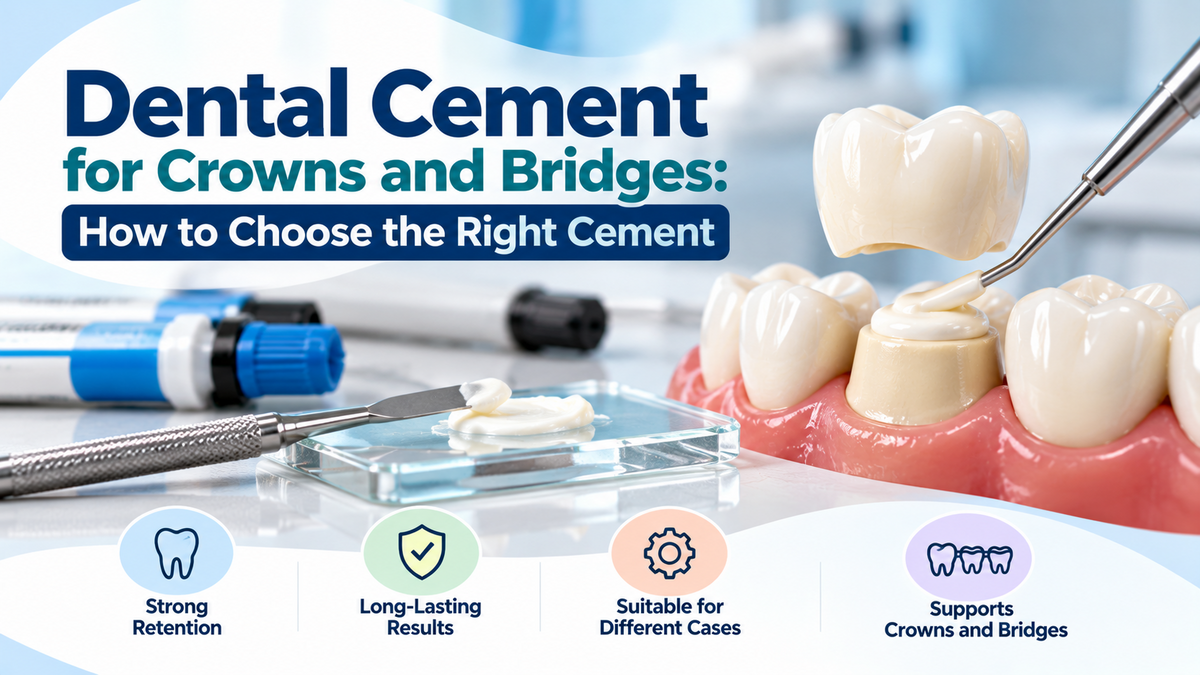
Choosing the right dental cement for a crown or bridge is about more than finding a strong adhesive. The cement has to work with the restoration material, preparation design, moisture conditions, retention, esthetic requirements, and clinical workflow.
That is why there is no single product that can be called the best dental glue for every bridge or crown. A cement that works well for a conventional metal-based restoration may not be the same choice for a zirconia or lithium disilicate restoration.
Modern dental practices can choose from glass ionomer, resin-modified glass ionomer (RMGI), resin cement, and self-adhesive resin cement, each with different properties and indications.
This guide explains the main options and how clinicians can approach cement selection for crowns and bridges.
What Is Dental Cement Used for?
Dental cement provides retention and sealing between an indirect restoration and the prepared tooth.
Depending on the material and clinical situation, cement can be used for:
Crowns
Fixed dental bridges
Inlays and onlays
Selected posts and cores
Other indirect restorations
The cement should provide appropriate retention while helping seal the restoration-tooth interface. Some formulations also provide specific advantages such as fluoride release, improved adhesion, low film thickness, or high mechanical strength.
The restoration material itself is one of the first factors to consider.
Types of Dental Cement for Crowns and Bridges
Glass Ionomer Cement
Traditional glass ionomer cement has been used for conventional cementation for many years.
Its advantages can include fluoride release, chemical interaction with tooth structure, and relatively straightforward handling.
However, traditional glass ionomer is more sensitive to early moisture contamination and generally does not provide the same adhesive performance as modern resin systems.
It can be appropriate for selected conventional crowns and bridges when the preparation provides adequate mechanical retention.
Resin-Modified Glass Ionomer Cement
RMGI cement combines glass ionomer chemistry with resin components.
RMGI products are widely used for conventional cementation because they offer a practical balance between handling, strength, moisture tolerance, and ease of cleanup.
They can be particularly useful when the preparation provides adequate retention and the clinician does not require the adhesive protocol associated with conventional resin cement.
FujiCEM is an example of a resin-modified glass ionomer cement used for cementation procedures.
Resin Cement
Resin cements provide strong adhesion and are available in multiple curing and handling configurations.
They can be especially useful when adhesive bonding is important, including selected minimally retentive preparations and certain esthetic restorations.
Depending on the product, resin cement may be:
Light-cured
Dual-cured
Self-cured
Adhesive
Self-adhesive
The appropriate system depends on the restoration, preparation, available light transmission, and manufacturer's instructions.
Self-Adhesive Resin Cement
Self-adhesive resin cements are designed to simplify cementation by reducing or eliminating some of the separate etching, priming, and bonding steps required by conventional adhesive resin systems.
They can be attractive when clinicians want a streamlined workflow while still using a resin-based cement.
However, "self-adhesive" does not mean that every restoration can be cemented without surface preparation. Restoration-specific cleaning, conditioning, or primers may still be required.
Crown and Bridge Cement Selection at a Glance
Cement type | Common advantage | Considerations | Typical applications |
Glass ionomer | Simple conventional cementation | Requires adequate retention | Selected conventional crowns and bridges |
RMGI | Practical handling and cleanup | Not ideal for every adhesive indication | Many conventional crown and bridge cases |
Resin cement | Strong adhesive potential | More technique-sensitive | Selected ceramic and indirect restorations |
Self-adhesive resin | Simplified resin workflow | Follow restoration-specific instructions | Selected crowns, bridges and indirect restorations |
Self-cure resin | Chemical cure without relying entirely on light | Cure and cleanup characteristics vary | Selected cores, posts and indirect procedures |
The table is a starting point rather than a substitute for the manufacturer's instructions or the restoration manufacturer's bonding recommendations.
Which Cement Is Used With Zirconia Crowns?
Zirconia is commonly used for crowns and bridges because of its strength and durability.
For many zirconia restorations with adequate mechanical retention, conventional cementation with an appropriate RMGI cement may be considered.
When additional adhesion is needed, a resin-based cement system may be selected. The zirconia surface must be treated according to the cement and zirconia manufacturer's recommendations.
A critical point is that zirconia is not treated exactly like glass ceramics. Clinicians should not automatically apply the same etching protocol used for lithium disilicate.
Before cementation, verify:
The zirconia manufacturer's surface-treatment recommendations
Whether a primer is required
Whether the selected cement is indicated for zirconia
The preparation's retention and resistance form
The recommended cleaning protocol
Cementing Lithium Disilicate Crowns
Lithium disilicate is a glass ceramic and requires a different bonding approach from zirconia.
For many lithium disilicate restorations, adhesive resin cementation can be an important part of achieving the desired clinical result.
The ceramic surface is typically conditioned according to the ceramic manufacturer's instructions, followed by the appropriate bonding protocol.
Because lithium disilicate is etchable glass ceramic, its surface treatment should not simply be copied from a zirconia workflow.
Clinicians should confirm compatibility between the ceramic, etchant or conditioning system, primer, adhesive, and selected cement.
Cementing PFM Crowns and Bridges
Porcelain-fused-to-metal (PFM) restorations have a long history of use in fixed prosthodontics.
When a PFM crown or bridge has adequate preparation retention, conventional cementation may be appropriate depending on the clinical situation.
RMGI cements are commonly considered for this type of conventional cementation because they provide practical handling and cleanup characteristics.
Resin cement may be considered when additional adhesive performance is needed or when preparation geometry makes conventional retention less predictable.
The decision should account for the preparation, restoration design, occlusion, moisture control, and cement manufacturer's indications.
What Is the Best Dental Glue for Bridges?
Patients and buyers may search for "best dental glue for bridges," but clinicians should approach the question by identifying the type of bridge and clinical requirements.
For example, a conventional PFM bridge with a retentive preparation may require a different cement strategy than a ceramic bridge with limited mechanical retention.
Consider these questions before selecting a cement:
What is the restoration made from?
Zirconia, lithium disilicate, PFM, metal, and other materials have different surface-treatment requirements.
How retentive is the preparation?
A highly retentive preparation may allow conventional cementation, while a minimally retentive preparation may require an adhesive approach.
Can moisture be controlled?
Some cement systems are more technique-sensitive than others.
Is esthetics important?
For highly visible restorations, cement shade and optical properties may matter.
How easy does the cement need to be to clean?
Excess cement can be particularly important around crown margins and interproximal areas.
Where Does FujiCEM Fit?
FujiCEM is a resin-modified glass ionomer cement used for luting indirect restorations.
Its practical workflow makes RMGI an important category for crown-and-bridge cementation, particularly when the clinical case is suitable for conventional cementation.
For clinicians considering FujiCEM, the important question is not simply whether it is a good cement. Instead, ask whether an RMGI cement fits the restoration material, preparation retention, moisture conditions, and manufacturer's indications for the specific case.
This decision-based approach is more useful than selecting a cement solely by brand recognition.
What About DenMat Core Paste Self Cure?
DenMat Core Paste Self Cure is a self-curing resin-based material designed primarily for core buildup applications rather than serving as a universal crown-and-bridge luting cement.
This distinction is important when comparing products.
A material can appear in searches related to dental cement while having a different intended clinical purpose. Clinicians should always verify the product's indications before using it for crown or bridge cementation.
For crown and bridge procedures, select a product specifically indicated by its manufacturer for the intended luting application.
Cement Removal and Cleanup
Cement selection should also consider what happens after the restoration is seated.
Excess cement should be removed carefully before it fully sets, using the technique recommended for the selected material.
Common cleanup considerations include:
Remove Excess at the Appropriate Stage
Different cements have different working and cleanup windows. Waiting too long can make excess cement significantly harder to remove.
Protect the Gingival Margin
Careful removal around the cervical margin helps reduce the risk of leaving residual cement in the sulcus or interproximal areas.
Check Interproximal Areas
Dental floss, appropriate instruments, and other clinician-selected methods can help identify and remove residual interproximal cement.
Follow the Cement Manufacturer's Instructions
Some materials have specific recommendations for tack curing, gel-stage cleanup, instrument selection, or final curing.
Do not assume that the same cleanup technique works for every cement category.
How to Choose Dental Cement for a Crown or Bridge
A simple selection process can make cement choice more systematic.
Step 1: Identify the restoration material.
Determine whether the restoration is zirconia, lithium disilicate, PFM, metal, or another material.
Step 2: Evaluate preparation retention.
Determine whether conventional cementation provides sufficient retention and resistance.
Step 3: Review the manufacturer's instructions.
Check the restoration and cement manufacturers' recommendations for surface treatment and compatibility.
Step 4: Consider moisture control.
Select a cement system that fits the isolation achievable in the clinical situation.
Step 5: Consider esthetics.
For visible restorations, evaluate shade and translucency requirements where applicable.
Step 6: Plan cleanup before cementation.
Know the product's working time and recommended excess-cement removal technique.
Stocking Crown and Bridge Cements in a Dental Practice
A general practice may benefit from maintaining more than one cement category rather than relying on a single product for every indirect restoration.
A practical inventory can include an RMGI cement for appropriate conventional cementation cases and a resin or self-adhesive resin cement for cases requiring a different bonding strategy.
When purchasing from Sky Dental Supply, clinicians can compare stocked cement products according to material type, curing method, intended application, packaging, and manufacturer's recommendations.
The goal is to match the product to the procedure rather than treating every crown and bridge as the same cementation problem.
Final Takeaway
The right dental cement for crowns and bridges depends on the restoration material, preparation design, retention, moisture control, esthetic requirements, and manufacturer's instructions.
RMGI remains a practical option for many conventional cementation procedures. Resin cements can provide adhesive options when additional bonding is required, while self-adhesive resin systems can simplify selected workflows.
Zirconia, lithium disilicate, and PFM restorations should not automatically be treated with the same cementation protocol. Their material characteristics and surface-treatment requirements differ.
For clinicians and dental practices, the best approach is to maintain a selection of appropriate cements and choose based on the specific restoration and clinical situation.
FAQs About Dental Cement for Crowns and Bridges
What is the best dental glue for a bridge?
There is no single cement appropriate for every bridge. Selection depends on the bridge material, preparation retention, moisture control, and manufacturer recommendations.
Can RMGI cement be used for crowns?
RMGI cements are commonly used for selected conventional crown cementation when the preparation and restoration are appropriate for that type of cement.
What cement is commonly used for zirconia crowns?
Depending on preparation retention and the clinical situation, zirconia crowns may be conventionally cemented or bonded with an appropriate resin-based system. Always follow the zirconia and cement manufacturers' instructions.
Does lithium disilicate require resin cement?
Many lithium disilicate restorations are adhesively cemented with resin cement, but the appropriate protocol depends on the restoration design and manufacturer's instructions.
Can FujiCEM be used for bridges?
FujiCEM is an RMGI luting cement that may be used for appropriate indirect restorations when its indications and the restoration manufacturer's recommendations support its use.
How do you remove excess dental cement?
Excess cement should be removed using a technique appropriate for the specific material and at the stage recommended by its manufacturer. Particular attention should be given to margins and interproximal areas.