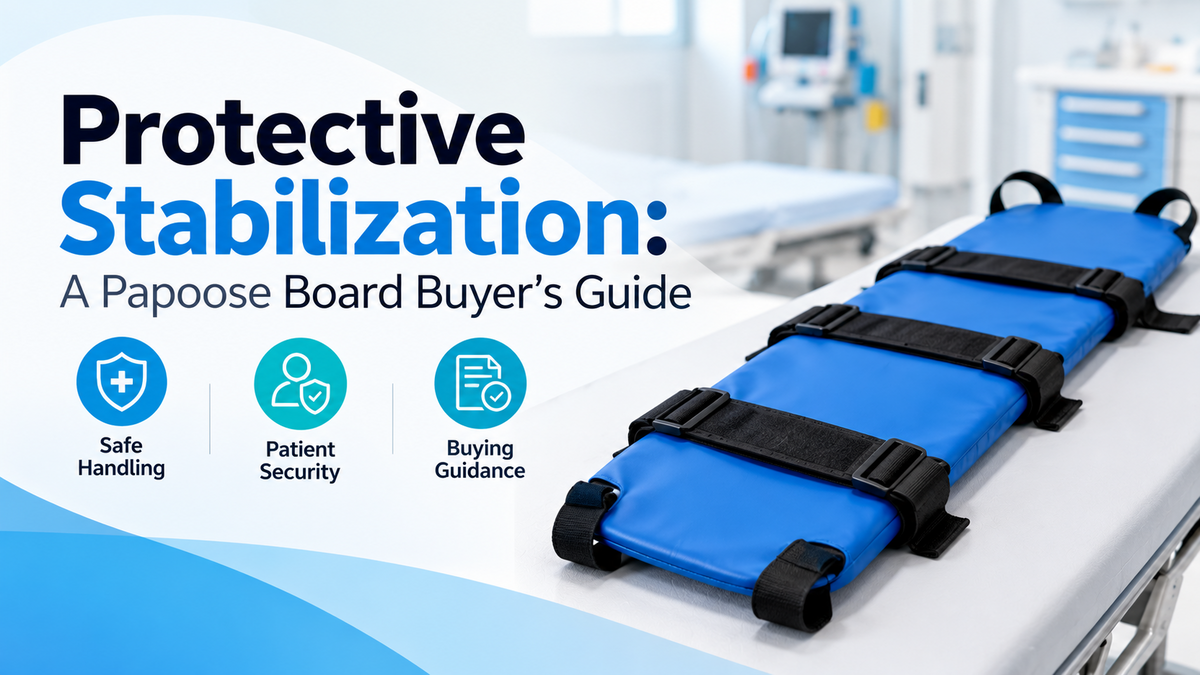
A papoose board is one of the most recognizable forms of protective stabilization used in pediatric and special-care dentistry. It is also one of the products that requires the most careful clinical consideration. A dental papoose board is not simply another piece of equipment to purchase for a pediatric operatory. Its use involves patient selection, informed consent, clinical judgment, monitoring, documentation, and consideration of less restrictive alternatives.
The American Academy of Pediatric Dentistry (AAPD) describes protective stabilization as an advanced behavior guidance technique and emphasizes that decisions should be individualized according to the patient's dental and medical history, developmental needs, alternatives, well-being, and the wishes of the parent or guardian.
For dental practices researching a papoose board dental option, the important question is therefore not simply, “Which board should we buy?” It is, “When is protective stabilization appropriate, and what equipment can support its safe, appropriate use?”
What Is a Papoose Board?
A papoose board is a type of protective stabilization device designed to limit movement during certain medical or dental procedures. In dentistry, it may be considered when a patient cannot cooperate sufficiently for necessary treatment and uncontrolled movement could create a safety risk.
The term “Papoose Board” is also associated with specific commercial products, while protective stabilization is the broader clinical concept.
AAPD guidance explains that protective stabilization may involve manual methods or devices and that the least restrictive approach that is safe and effective should be considered. Full-body stabilization devices are among the equipment options described for patients who cannot adequately control movement because of certain medical or behavioral circumstances.
This distinction matters. A dental papoose board should not be viewed as a routine solution for an uncooperative child or as a substitute for communication and behavior guidance.
When Might Protective Stabilization Be Considered?
Protective stabilization may be considered when medically necessary dental care cannot be delivered safely using less restrictive approaches.
According to the AAPD, treatment should generally first be approached using communicative behavior guidance unless there is a known history of maladaptive or combative behavior that could cause injury. Protective stabilization should be used only when less restrictive interventions are ineffective or when the clinical circumstances justify it.
Potential clinical considerations can include:
Significant uncontrolled or impulsive movement
Involuntary movements that could interfere with treatment
Certain special health care needs
A patient's inability to cooperate with necessary treatment
A situation in which sudden movement could create a risk of injury
The need to provide necessary care when alternative approaches have not been effective
The decision should be individualized. The patient's dental needs, medical and physical considerations, emotional development, quality of care, and available alternatives all form part of the decision-making process.
Importantly, protective stabilization must not be used as punishment, retaliation, or simply for practitioner convenience.
What Should Be Tried Before a Papoose Board?
Protective stabilization exists within a much broader behavior-guidance framework.
AAPD identifies basic behavior guidance approaches such as communication, tell-show-do, positive reinforcement, distraction, desensitization, modeling, and other patient-centered techniques. For some patients, additional approaches may include sensory-adapted environments, breathing techniques, nitrous oxide-oxygen inhalation, sedation, or general anesthesia.
Depending on the patient and procedure, alternatives may include:
Communication and behavior guidance
A child may respond to age-appropriate explanations, tell-show-do, positive reinforcement, distraction, gradual exposure, or desensitization.
Treatment modification or deferral
In selected cases, treatment can be modified, divided into shorter appointments, or deferred when clinically appropriate.
Pharmacological behavior guidance
Sedation may be considered when clinically indicated and when the practice has the appropriate training, equipment, monitoring, and emergency capabilities. AAPD and the American Academy of Pediatrics maintain specific guidance for pediatric sedation.
General anesthesia
For selected patients and procedures, general anesthesia may be considered instead of protective stabilization. This requires appropriate patient assessment, qualified providers, monitoring, and facilities.
The point is not that one method is universally preferable. The appropriate approach depends on the individual patient, treatment requirements, risks, available alternatives, and clinical judgment.
Consent Is a Central Part of Protective Stabilization
One of the most important considerations when evaluating a papoose board dental option is consent.
AAPD states that protective stabilization performed by the dental team requires informed consent from a parent or guardian. The discussion should address the reason for stabilization, expected benefits, risks, and available alternatives. The patient should also be involved in the discussion in an age- and developmentally appropriate manner.
Consent should not be treated as a simple signature on a form.
A meaningful discussion can include:
Why stabilization is being considered
What type of stabilization will be used
Why less restrictive approaches may not be sufficient
Potential risks and benefits
Available alternatives
How the patient will be monitored
How long stabilization is expected to be used
What circumstances would lead the clinician to stop or modify the approach
AAPD guidance also recognizes the parent's role in decision-making and indicates that a parent has the right to terminate protective stabilization if they believe the child is experiencing physical or psychological trauma from immobilization.
Practices should also consider applicable state laws, regulations, professional requirements, and facility policies.
Documentation Matters
Protective stabilization should be documented as part of the patient's clinical record.
AAPD guidance identifies documentation elements including the indication for stabilization, the type of stabilization, informed consent, duration of application, behavior during stabilization, and any untoward outcomes.
For a dental practice, documentation may therefore address:
The clinical reason stabilization was considered.
The behavior guidance approaches attempted or considered.
The type of protective stabilization used.
Consent obtained from the parent or guardian.
Relevant patient communication or assent when appropriate.
Duration and method of stabilization.
Monitoring during treatment.
Any adverse or unexpected events.
Implications for future appointments.
Good documentation supports continuity of care and allows the dental team to understand what occurred during a previous visit.
Choosing a Dental Papoose Board: What Should Practices Consider?
Once a practice has established a legitimate clinical need for protective stabilization, equipment selection becomes important.
A papoose board should be evaluated as part of a complete clinical process rather than purchased based solely on price.
1. Size and patient fit
The device should be appropriate for the patient's body size and intended clinical use. A board that is too large or too small may affect positioning, comfort, stability, and clinical access.
Review the manufacturer's stated dimensions, recommended patient size or weight range, and adjustment features.
2. Adjustability
Look at how the stabilization components adjust and whether the system can accommodate different patients without creating unnecessary restriction.
Adjustability can be particularly important for practices treating a range of pediatric patients.
3. Compatibility with the dental chair
A flat stabilization board may not naturally conform to every dental chair. AAPD specifically notes that some flat-board designs may not adapt easily to the dental chair and that positioning supports may sometimes be necessary.
Before purchasing, practices should evaluate the device in the actual operatory where it will be used.
4. Patient access
The dental team needs appropriate access to the oral cavity and treatment area while maintaining safe positioning.
Consider whether the design interferes with:
Dental chair positioning
Operator access
Assistant access
Radiographic procedures when applicable
Emergency access
Monitoring
Other required clinical equipment
5. Materials and cleaning
Because dental environments require infection-control procedures, practices should review manufacturer instructions for cleaning, disinfection, and maintenance.
Do not assume that a particular material is compatible with every disinfectant. Follow the manufacturer's instructions and the practice's infection-control protocols.
6. Secure but appropriate stabilization
The goal is not maximum restriction. AAPD emphasizes individualized use and the least restrictive safe and effective approach.
Practices should therefore evaluate how the device achieves stabilization and whether adjustments can be made appropriately for individual patients.
7. Training and instructions
Equipment alone does not create a safe protective-stabilization program.
AAPD recommends that practitioners have appropriate didactic and hands-on education beyond dental school, while staff should be trained in safe and humane use of stabilization techniques.
Before purchasing a dental papoose board, practices should identify who will use it, what training is required, and what internal protocols govern its use.
How Much Does a Papoose Board Cost?
The answer to “papoose board dental price” depends on the specific product, size, manufacturer, included components, and supplier.
Prices can vary substantially, so practices should compare the complete specification rather than choosing solely on the lowest advertised price.
When evaluating a quotation, check whether the price includes:
The stabilization board
Restraint components
Positioning accessories
Head-support components, if applicable
Manufacturer documentation
Warranty information
Shipping
Applicable replacement or accessory costs
A lower initial purchase price may not represent the lowest overall cost if the practice later needs additional accessories or replacement components.
For practices comparing pediatric dental equipment and supplies, Sky Dental Supply provides a broader dental-supply purchasing environment where clinicians and practices can review products according to their operational needs. Visit Sky Dental Supply to explore its dental supply range.
What About a Papoose Board?
Papoose Board is a product-specific term that may appear in searches for protective stabilization equipment. AAPD's current best-practice document references the Papoose Board as one example of a full-body stabilization device.
However, mentioning a particular product does not constitute an endorsement or recommendation by AAPD.
When comparing an Papoose Board or another dental stabilization product, practices should evaluate the same fundamentals: patient fit, adjustability, dental-chair compatibility, access, cleaning requirements, manufacturer instructions, staff training, and clinical appropriateness.
Papoose Board vs. Other Behavior Guidance Options
There is no universal “one-size-fits-all” approach to pediatric dental behavior management.
A patient who responds to communication and gradual exposure may not need advanced behavior guidance. Another patient with significant involuntary movement or uncontrolled behavior may require a different approach.
Protective stabilization, sedation, and general anesthesia are all considered advanced behavior guidance options, but they have different clinical requirements and risk considerations.
The relevant question for a dental practice is therefore not simply which method is easiest to implement. The question is which approach is clinically appropriate for the individual patient and treatment being provided.
Frequently Asked Questions
1. What is a papoose board used for?
A papoose board is a protective stabilization device that may help limit uncontrolled movement during certain dental procedures when clinically appropriate.
2. Is a papoose board safe for dental use?
When properly indicated, applied, and monitored by trained dental professionals, protective stabilization can be used as part of appropriate patient care.
3. When should a dental papoose board be used?
It may be considered when necessary treatment cannot be safely completed using less restrictive behavior-guidance techniques.
4. How much does a dental papoose board cost?
Papoose board dental prices vary by manufacturer, size, model, features, and included accessories. Practices should compare total cost and specifications.
5. Is parental consent required for a papoose board?
Informed consent from a parent or legal guardian is generally required for pediatric protective stabilization, subject to applicable laws and professional requirements.
6. What should dentists consider when buying a papoose board?
Consider patient size, adjustability, dental-chair compatibility, monitoring access, cleaning requirements, manufacturer instructions, staff training, and overall cost.
Final Thoughts
A papoose board should never be treated as an ordinary pediatric dental accessory. Protective stabilization is a clinical intervention that requires individualized assessment, appropriate training, informed consent, monitoring, documentation, and consideration of alternatives.
Current AAPD guidance emphasizes that protective stabilization should be incorporated into an overall behavior-guidance plan and used only when clinically appropriate. Less restrictive approaches should be considered first when they can safely achieve the treatment objective.
For dental practices researching a dental papoose board, the purchasing decision should therefore begin with clinical need and safety rather than price alone. Once the practice has established that protective stabilization is appropriate, factors such as patient size, adjustability, chair compatibility, cleaning requirements, training, monitoring, manufacturer instructions, and total cost can help inform equipment selection.