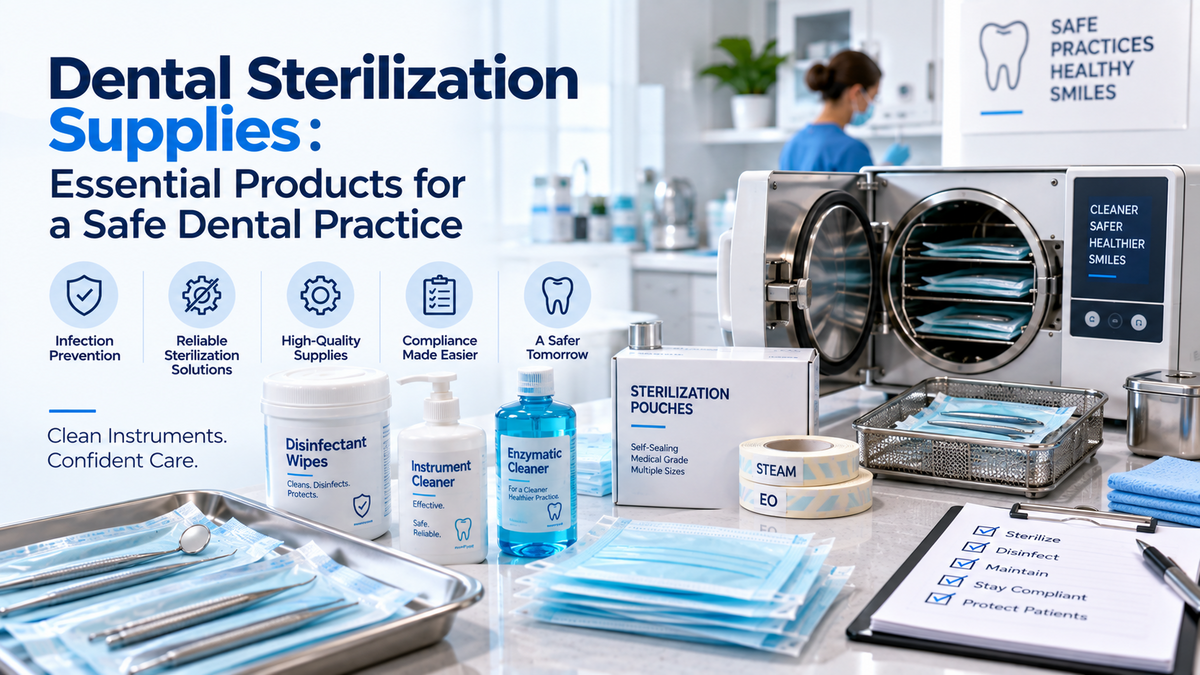
A dental practice depends on many things to deliver safe and efficient patient care, but few are as important as a reliable infection control and sterilization process. Every day, dental instruments and equipment may come into contact with saliva, blood, oral tissues, and other potentially infectious materials. Proper cleaning, packaging, sterilization, monitoring, and storage help ensure that reusable instruments are safe for the next patient.
This is why choosing the right dental sterilization supplies is an important part of managing any dental office. From sterilization pouches and indicators to autoclaves, instrument trays, cleaning solutions, and other infection-control products, every item has a role in supporting an organized sterilization workflow.
According to the Centers for Disease Control and Prevention (CDC), reusable dental instruments need to go through appropriate reprocessing steps, and manufacturers' validated instructions should always be followed.
Why Dental Sterilization Is So Important
Dental professionals work in an environment where instruments can become contaminated during routine procedures. If reusable instruments are not properly processed between patients, microorganisms and organic material can remain on their surfaces.
Sterilization is different from simple cleaning or disinfection. Cleaning removes debris and organic material, while sterilization is intended to eliminate microorganisms, including bacterial spores. The CDC recommends that dental practices establish consistent procedures for containing, transporting, cleaning, packaging, sterilizing, and storing reusable instruments.
A properly designed sterilization workflow can help a practice:
Reduce the risk of cross-contamination
Protect patients and dental professionals
Maintain consistent infection-control procedures
Support compliance with applicable requirements
Keep instruments organized and ready for use
Improve efficiency in the sterilization area
Sterilization should not be treated as an occasional task. It needs to be part of the practice's routine from the moment a contaminated instrument leaves the treatment area until the sterilized instrument is safely stored.
Essential Dental Sterilization Supplies for a Dental Office
A complete sterilization setup involves more than an autoclave. Dental practices typically need a combination of equipment, packaging materials, monitoring products, cleaning supplies, and protective equipment.
1. Dental Autoclaves and Sterilizers
The sterilizer is one of the most important pieces of equipment in a dental practice. Steam autoclaves are commonly used because many dental instruments are heat-tolerant.
An autoclave uses controlled heat, pressure, and time to sterilize compatible instruments. However, different instruments and sterilizers can have different processing requirements, so dental professionals should follow the manufacturer's instructions for use.
When choosing a sterilizer, practices may consider:
Chamber capacity
Cycle options
Instrument volume
Loading requirements
Monitoring features
Maintenance requirements
Available space
Electrical specifications
For busy practices, selecting an appropriately sized sterilizer can help prevent bottlenecks in instrument processing.
Sky Dental Supply offers a selection of dental sterilizers and autoclaves, including models from manufacturers such as SciCan and Tuttnauer.
2. Sterilization Pouches and Packaging
Sterilization packaging is another essential part of the process. Once instruments have been cleaned and thoroughly dried, they can be packaged before sterilization according to the manufacturer's instructions.
Sterilization pouches help protect processed instruments from contamination during storage and handling. Proper packaging also allows sterilization agents to reach the instruments while helping maintain sterility after processing.
Before using a packaged instrument, dental staff should inspect the pouch for problems such as tears, punctures, moisture, or compromised seals. The CDC recommends reprocessing instruments if their sterile packaging has been compromised.
3. Chemical Indicators
Chemical indicators help dental teams verify that appropriate sterilization conditions have been reached. They can be incorporated into packaging or used inside sterilization loads, depending on the product and manufacturer's instructions.
A chemical indicator should be checked after the sterilization cycle. If the expected indicator response has not occurred, the instruments should not be considered ready for patient use.
Chemical indicators are an important part of a broader monitoring system and should not be viewed as the only method of verifying sterilization.
4. Biological Indicators and Spore Tests
Biological monitoring, commonly associated with spore testing, provides another level of sterilization verification. Biological indicators use highly resistant microorganisms to evaluate whether the sterilization process is functioning effectively.
The CDC recommends using a biological indicator at least weekly for sterilizer monitoring, along with the appropriate control, and recommends biological monitoring for every load containing an implantable device.
Dental practices should maintain appropriate sterilization monitoring records and follow applicable regulations and manufacturer instructions.
5. Instrument Cleaning Supplies
Sterilization cannot replace proper cleaning. Instruments should be cleaned before they are sterilized because blood, saliva, tissue, and other debris can interfere with the sterilization process.
Dental practices may use manual cleaning methods or automated equipment such as ultrasonic cleaners and washer-disinfectors. Automated cleaning can improve consistency and reduce staff exposure to contaminated instruments.
Depending on the practice's workflow, cleaning supplies may include:
Instrument cleaning solutions
Ultrasonic cleaning accessories
Instrument brushes
Cleaning trays
Detergents
Instrument-care products
The goal is to remove visible contamination before instruments move into the packaging and sterilization stages.
6. Sterilization Trays and Instrument Containers
Sterilization trays and containers help organize instruments throughout the reprocessing workflow. They can make it easier for staff to transport, load, and handle instruments while reducing unnecessary handling.
A well-organized tray system can also help dental teams separate instruments by procedure or treatment room. Practices should select containers that are compatible with their sterilization equipment and follow the manufacturer's instructions.
7. PPE for Instrument Reprocessing
Personal protective equipment is essential when dental staff handle contaminated instruments. Depending on the task and practice protocol, PPE may include utility gloves, masks, protective eyewear or face shields, and protective clothing.
The CDC recommends appropriate PPE when handling and reprocessing contaminated patient-care equipment. Contaminated instruments should also be transported carefully in appropriate covered, puncture-resistant, and leak-proof containers.
8. Sterilization Monitoring and Documentation Supplies
Good infection control involves more than processing instruments. Dental practices should also maintain appropriate records.
Monitoring may involve mechanical, chemical, and biological indicators. Sterilization records can help a practice identify problems and determine which instruments may need to be reprocessed if a sterilization failure occurs.
Labels and documentation systems can also help identify:
Sterilizer used
Cycle or load number
Sterilization date
Expiration date, where applicable
Organized documentation makes the sterilization process easier to track and manage.
Understanding Critical, Semicritical, and Noncritical Items
Not every dental item requires exactly the same level of processing. The CDC classifies patient-care items according to the risk associated with their intended use.
Critical items penetrate soft tissue or bone. Examples can include surgical instruments and periodontal scalers. These items have the highest infection-transmission risk and should be heat sterilized when reusable.
Semicritical items come into contact with mucous membranes or non-intact skin. Most heat-tolerant semicritical dental items should also be heat sterilized. Heat-sensitive items require appropriate alternative processing according to current guidance and manufacturer instructions.
Noncritical items contact intact skin and generally require cleaning and, when visibly soiled, appropriate disinfection.
This classification helps dental teams determine the correct processing approach rather than applying one method to every item.
The Dental Sterilization Workflow
An effective sterilization process should follow a consistent sequence.
Step 1: Collect and Transport Contaminated Instruments
Used instruments should be handled carefully and transported from the treatment area to the designated processing area using appropriate containers.
Step 2: Clean the Instruments
Cleaning removes visible contamination and organic material. Manual or automated cleaning methods may be used depending on the instruments and practice setup.
Step 3: Rinse and Dry
After cleaning, instruments should be rinsed as appropriate and dried thoroughly. Moisture can compromise packaging and interfere with maintaining sterile conditions.
Step 4: Inspect and Package
Staff should inspect instruments for cleanliness and condition before placing them into appropriate sterilization pouches, wraps, or containers.
Step 5: Sterilize
The packaged instruments are placed into the appropriate sterilizer cycle based on the equipment and instrument manufacturer's validated instructions.
Step 6: Monitor the Cycle
Mechanical, chemical, and biological monitoring should be incorporated according to applicable recommendations and product instructions.
Step 7: Store Properly
Sterilized instruments should be stored in suitable covered or closed cabinets. Packages should be checked before use to make sure they remain intact and dry.
How to Choose the Right Dental Sterilization Supplies
Buying sterilization products should be based on the actual needs of the practice rather than simply selecting the cheapest available option.
Consider the following factors:
Compatibility: Make sure pouches, indicators, trays, containers, and other supplies are compatible with the sterilizer and instruments being processed.
Quality: Infection-control supplies play a direct role in the reprocessing workflow, so product quality matters.
Practice volume: A high-volume dental practice may require greater quantities of pouches, indicators, cleaning products, and instrument-processing equipment.
Ease of use: Products should fit naturally into the practice's workflow and be straightforward for trained staff to use.
Manufacturer instructions: Always follow the instructions supplied with the sterilizer, instruments, packaging, and monitoring products.
Storage: Consider how sterilized instruments and supplies will be organized after processing.
Why Choose Sky Dental Supply for Dental Sterilization Products?
Finding a dependable supplier can simplify the process of maintaining dental inventory. Sky Dental Supply provides dental practices with access to a broad selection of dental supplies, instruments, equipment, and infection-control products.
The company states that it stocks more than 20,000 products and works with more than 100 dental suppliers. Its product categories include infection control, dental instruments, disposables, gloves, implant products, impression materials, and other dental practice essentials.
For practices specifically looking for sterilization equipment, Sky Dental Supply offers dental sterilizers from established manufacturers, including SciCan and Tuttnauer. Its catalog includes different autoclave capacities and configurations designed for different practice requirements.
A supplier that can provide multiple categories of dental products can make purchasing more convenient, especially for practices that need to replenish infection-control supplies alongside everyday clinical products.
Build a More Organized Sterilization Area
A safe sterilization process starts with organization. The reprocessing area should have a clear workflow that separates contaminated instruments from clean and sterile items.
Staff should know where instruments are received, cleaned, inspected, packaged, sterilized, and stored. Keeping frequently used dental sterilization supplies properly stocked can also help prevent interruptions.
Practices should regularly review their inventory of:
Sterilization pouches
Chemical indicators
Biological indicators
Instrument cleaning products
Trays and containers
PPE
Autoclave accessories
Sterilizer maintenance supplies
Regular inventory checks can help avoid running out of essential products during a busy clinical day.
Final Thoughts
Dental sterilization is a fundamental part of patient safety and infection prevention. An effective program requires more than simply owning an autoclave. Dental practices need the right combination of cleaning products, packaging materials, monitoring indicators, trays, PPE, sterilization equipment, storage solutions, and documentation procedures.
The most important point is consistency. Instruments should be processed according to established procedures and manufacturer instructions every time. The CDC emphasizes that cleaning, packaging, sterilization, monitoring, and storage all contribute to effective instrument reprocessing.
For dental practices looking to source dental sterilization supplies, Sky Dental Supply provides access to a broad dental product catalog along with sterilization equipment and infection-control categories. By choosing appropriate products and maintaining a well-organized workflow, dental teams can support safer and more efficient everyday patient care.
Frequently Asked Questions
1. What are dental sterilization supplies?
Dental sterilization supplies include products used to clean, package, sterilize, monitor, transport, and store reusable dental instruments. Examples include sterilization pouches, indicators, trays, cleaning products, autoclaves, and related accessories.
2. What is the most commonly used dental sterilizer?
Steam autoclaves are commonly used in dental practices for heat-tolerant instruments. The appropriate sterilization method depends on the instrument, sterilizer, and manufacturer's validated instructions.
3. Are sterilization pouches necessary?
Sterilization packaging helps protect processed instruments from contamination during handling and storage. Dental practices should select packaging compatible with their sterilization system and follow the manufacturer's instructions.
4. How often should dental sterilizers be monitored?
Monitoring requirements depend on the type of monitoring being performed and applicable recommendations. The CDC recommends biological indicator testing at least weekly and for every load containing an implantable device. Practices should also use mechanical and chemical monitoring appropriately.
5. Why are chemical indicators used in dental sterilization?
Chemical indicators provide a visual indication that specified sterilization conditions have been reached. They are part of a broader monitoring process and should be used according to the product manufacturer's instructions.
6. Can all dental instruments be sterilized in an autoclave?
No. Instruments differ in their materials and heat tolerance. Dental professionals should follow the manufacturer's validated reprocessing instructions. Most heat-tolerant critical and semicritical items should be heat sterilized, while appropriate alternatives may be required for heat-sensitive items.
7. Where can dental practices buy sterilization equipment and supplies?
Dental practices can source sterilization equipment and related infection-control products from specialized dental suppliers. Sky Dental Supply offers dental sterilizers and a broad selection of dental supplies for practices.