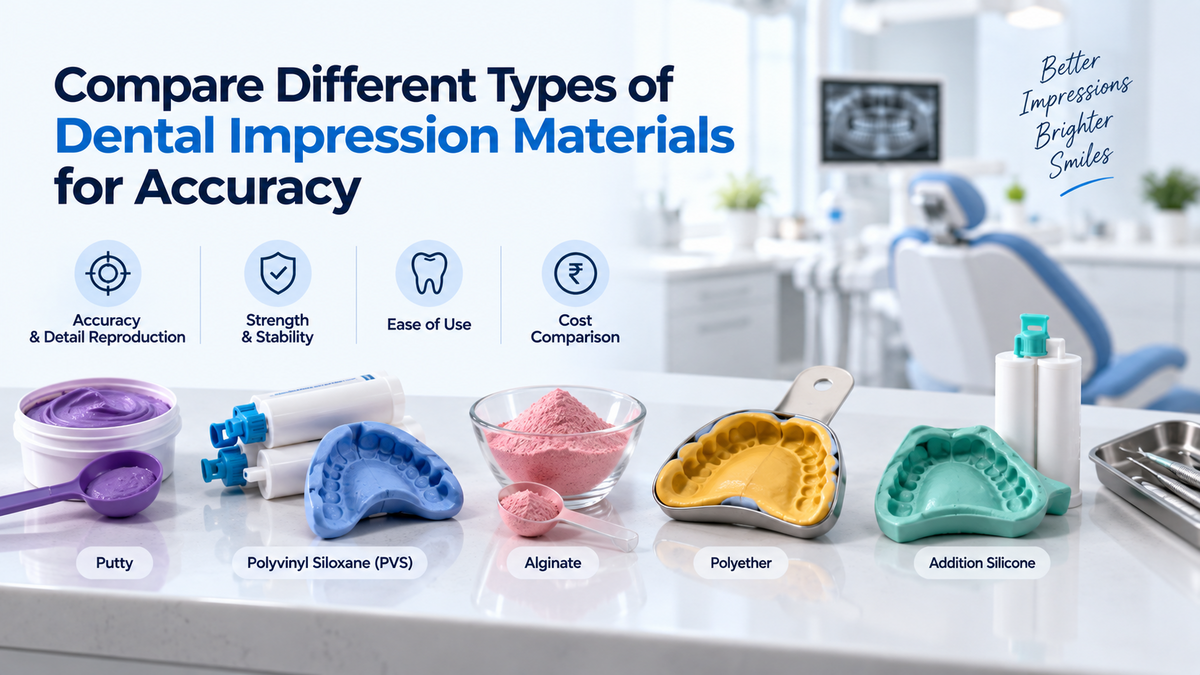
Dental impressions remain an important part of many restorative, orthodontic, prosthodontic, and diagnostic procedures. A well-made impression captures the shape, position, and surface details of teeth and surrounding oral tissues so a dentist or dental laboratory can create an accurate model. The quality of that final model depends on several factors, including the impression material, tray selection, mixing technique, moisture control, working time, and how quickly the impression is processed.
With several types of dental impression materials available, choosing the right option can sometimes be difficult. Alginate, polyether, polyvinyl siloxane (PVS), condensation silicone, impression compound, hydrocolloid, and zinc oxide eugenol each have different characteristics. Some are valued for affordability and convenience, while others are preferred when dimensional stability and fine detail reproduction are especially important.
This guide compares common dental impression materials based on accuracy, dimensional stability, handling, moisture tolerance, flexibility, and typical clinical applications.
What Makes a Dental Impression Accurate?
Accuracy is more than simply creating a recognizable impression of the teeth. A clinically useful impression should reproduce important anatomical details without significant distortion or dimensional change.
Several factors influence accuracy:
Fine surface-detail reproduction
Dimensional stability after setting
Resistance to tearing during removal
Adequate elasticity and recovery
Proper tray fit and rigidity
Appropriate working and setting time
Compatibility with oral moisture
Correct mixing and placement technique
Proper disinfection and storage
Timely pouring or scanning of the impression
The impression tray is also an important part of the process. A tray carries and controls the material while it is placed in the mouth and helps maintain the shape of the impression during removal. Sky Dental Supply explains that rigid trays can help retain their shape during impression taking and subsequent model construction, with full-arch, sectional, and quadrant options available for different cases.
Alginate Impression Material: Convenient and Cost-Effective
Alginate is one of the most widely used irreversible hydrocolloid impression materials. It is popular because it is relatively inexpensive, easy to mix, and generally comfortable for patients.
Alginate is commonly selected for:
Preliminary impressions
Study models
Orthodontic records
Diagnostic casts
Opposing-arch impressions
Some removable appliance procedures
Its main limitation is dimensional stability. Alginate can lose or gain water depending on environmental conditions, which can affect the accuracy of the impression if it is not handled and poured appropriately.
For this reason, alginate is generally not the first choice when extremely precise dimensional reproduction is required for highly demanding restorative work.
Sky Dental Supply carries alginate options as part of its broader impression-material selection, including Cavex Orthotrace. Its product information describes the material as a fast-setting alginate designed for dental impression applications.
Accuracy level: Good for diagnostic and preliminary applications, but generally less dimensionally stable than elastomeric materials.
Polyvinyl Siloxane (PVS): A Strong Choice for Precision
Polyvinyl siloxane, often called PVS or addition silicone, is widely used when accurate reproduction and dimensional stability are important.
PVS materials can provide excellent detail reproduction and are available in different viscosities, including light-body, medium-body, heavy-body, and putty materials. This makes them suitable for techniques where a low-viscosity material records fine details while a heavier material provides support.
PVS is frequently used for:
Implant impressions
Inlays and onlays
Fixed prosthodontic procedures
Detailed restorative impressions
One of its major advantages is dimensional stability. Compared with moisture-sensitive hydrocolloid materials, PVS can maintain its dimensions well when handled according to the manufacturer's instructions.
A comparative study of PVS, polyether, and condensation silicone reported lower dimensional discrepancy and stronger surface-detail reproduction for PVS under the study conditions.
Sky Dental Supply offers PVS products such as COLTENE AFFINIS Black Edition and describes the system as an option when extremely high precision is needed.
Accuracy level: Excellent, particularly for detailed fixed and implant-related procedures when correctly selected and handled.
Polyether: Excellent Detail and Stability
Polyether is another elastomeric impression material known for accurate reproduction and dimensional stability. It has traditionally been valued for its ability to capture fine details and maintain impression dimensions.
Polyether can be useful for:
Crown and bridge impressions
Implant impressions
Multiple-unit restorative cases
Situations where precise detail reproduction is required
One characteristic that distinguishes polyether from some silicone materials is its relatively stiff set. This can provide dimensional stability but may make removal more challenging in certain clinical situations, especially where there are significant undercuts.
A published comparison of impression materials found polyether to produce highly accurate casts when compared with alginate and hydrocolloid materials.
Sky Dental Supply offers products such as 3M Impregum Penta Soft Polyether Impression Material and Permadyne Penta Polyether Impression Material.
Accuracy level: Excellent, particularly when fine detail and dimensional stability are priorities.
Condensation Silicone: Flexible but More Sensitive to Dimensional Change
Condensation silicone is an elastomeric impression material that has been used in dentistry for many years. It offers good elasticity and can provide useful detail reproduction.
However, condensation silicone releases a by-product during polymerization, which can contribute to dimensional change over time. As a result, timing between impression taking and pouring can be more important than with highly dimensionally stable materials.
It may still be useful for selected clinical and laboratory applications, but dentists requiring maximum dimensional stability often consider newer elastomeric options.
In a comparative study involving PVS, polyether, and condensation silicone, condensation silicone showed greater dimensional discrepancy and lower complete surface-detail reproduction than the other two materials under the study conditions.
Accuracy level: Good, but generally less dimensionally stable than PVS and polyether.
Reversible Hydrocolloid: Accurate but Technique-Sensitive
Reversible hydrocolloid, commonly known as agar, can provide good detail reproduction. Unlike alginate, it can be softened and hardened repeatedly through temperature changes.
Its accuracy can be good when the material is properly conditioned and used with the appropriate equipment and technique.
However, hydrocolloid systems require more temperature control and clinical preparation than many modern elastomeric materials. They can also be affected by water loss or absorption.
Historically, research comparing hydrocolloid and alginate materials found reversible hydrocolloid to produce more accurate casts than the irreversible alginates evaluated in that study.
Accuracy level: Good to very good when carefully handled, but technique and dimensional stability requirements can make it less convenient than modern elastomers.
Impression Compound: Useful for Preliminary and Functional Procedures
Impression compound is a thermoplastic material that becomes softer when heated and harder when cooled. Because it can be softened and manipulated, it has traditionally been used for preliminary impressions and border molding.
It can be useful for:
Edentulous impressions
Preliminary denture impressions
Border molding
Custom tray procedures
Its accuracy for fine surface detail is generally lower than that of modern elastomeric materials. It is therefore often selected for situations where its moldability and rigidity after cooling are more important than extremely fine detail reproduction.
Sky Dental Supply lists GC America's ISO FUNCTIONAL package among its compound impression-material options.
Accuracy level: Suitable for preliminary and functional procedures, but not usually the first choice for highly detailed fixed prosthodontic impressions.
Zinc Oxide Eugenol: Useful for Edentulous Applications
Zinc oxide eugenol, commonly abbreviated as ZOE, is another impression material used primarily in certain edentulous and removable prosthodontic procedures.
When properly mixed and used with an appropriate tray, ZOE can provide good surface detail. It is relatively rigid after setting, so it is generally more appropriate for cases without significant undercuts.
Typical uses include:
Final impressions for complete dentures
Edentulous ridge impressions
Selected removable prosthodontic procedures
Sky Dental Supply offers products such as Plastopaste Zinc Oxide Eugenol Impression Paste and GC America's COE-FLO Standard Package.
Accuracy level: Good for appropriate edentulous applications, particularly when rigidity and detail reproduction are beneficial.
Why the Impression Tray Matters for Accuracy
Even the best impression material cannot compensate for an unsuitable tray.
The tray should provide adequate space for the impression material while remaining stable during seating and removal. A tray that flexes, moves, or provides inadequate material thickness can contribute to distortion.
Sky Dental Supply offers a broad selection of impression trays, including disposable, autoclavable, heat-moldable, metal, implant, bite, full-arch, sectional, and quadrant options.
For example, the company's catalog includes BeeSure True Impression 3-in-1 Trays with Stainless Steel Connectors, Coe Tray SS Solid, Coe Trays Perforated, Crystal Clear Impression Trays, and Dentray II Perforated Impression Trays.
Explore Impression Trays at Sky Dental Supply
Perforated trays can provide mechanical retention for compatible materials, while solid trays may be paired with appropriate tray adhesive. The choice should depend on the material, technique, arch anatomy, and procedure.
How to Choose the Most Accurate Impression Material
There is no single impression material that is perfect for every dental procedure. The best choice depends on the clinical objective.
For study models and preliminary impressions, alginate can be a practical choice because it is economical and easy to use.
For crowns and bridges, PVS or polyether may be preferred because of their excellent detail reproduction and dimensional stability.
For implant impressions, highly accurate elastomeric materials such as PVS or polyether can be appropriate depending on the clinical technique and manufacturer's instructions.
For complete denture procedures, impression compound, ZOE, alginate, or elastomeric materials may be selected at different stages depending on whether the goal is a preliminary, border-molding, or final impression.
The material should always be selected according to the specific procedure and used according to the manufacturer's instructions.
Tips for Improving Impression Accuracy
Choosing a premium material is only one part of obtaining an accurate impression. Good clinical technique is equally important.
1. Select the Correct Tray Size
The tray should adequately cover the required anatomy without excessive compression of soft tissue. It should also allow enough room for the selected impression material.
2. Check Tray Rigidity
A flexible tray can potentially distort during seating or removal. Rigid trays can help maintain the intended impression geometry.
3. Control Moisture
Excess saliva, blood, or moisture can interfere with certain materials and reduce surface-detail reproduction. Appropriate isolation and tissue management are important.
4. Follow Mixing Instructions
Incorrect ratios, inadequate mixing, or inconsistent manipulation can affect setting behavior and impression quality.
5. Respect Working and Setting Times
The material should be inserted and seated within its working time. Premature removal can distort an impression.
6. Remove the Impression Carefully
Elastomeric materials require appropriate removal technique. Excessive rocking or uneven force may distort impression margins or anatomical structures.
7. Disinfect Correctly
Impressions should be disinfected using procedures compatible with the material. Some materials may be more sensitive to prolonged immersion or inappropriate solutions.
8. Pour or Process at the Recommended Time
Material-specific instructions should be followed for pouring, storage, and laboratory processing. This is particularly important for materials with greater dimensional sensitivity.
Why Sky Dental Supply Can Be a Useful Source for Impression Supplies
Sky Dental Supply provides dental professionals with a broad selection of impression-related products rather than limiting its catalog to one material or tray style. Its current impression-material category includes alginates, polyethers, hydrocolloids, silicones, rubber-based materials, VPS products, impression compounds, and ZOE/non-ZOE pastes.
The company also offers a substantial selection of impression trays, with categories covering disposable, autoclavable, heat-moldable, metal, implant, and bite-registration trays.
This variety can make it easier for dental practices to compare products based on the procedure they perform, the impression technique they use, and their supply requirements.
Shop Dental Impression Materials from Sky Dental Supply
Frequently Asked Questions
Which dental impression material is the most accurate?
PVS and polyether are generally considered excellent choices when high accuracy and dimensional stability are required. The best option depends on the specific procedure, technique, and manufacturer's instructions.
Is alginate accurate enough for dental impressions?
Alginate can provide adequate accuracy for preliminary impressions, study models, orthodontic records, and other diagnostic applications. It is generally less dimensionally stable than PVS or polyether.
Is PVS better than alginate?
For highly detailed restorative impressions, PVS generally offers better dimensional stability and fine-detail reproduction. Alginate remains useful for many diagnostic and preliminary applications because it is economical and easy to handle.
Which material is commonly used for crown and bridge impressions?
PVS and polyether are commonly selected for fixed prosthodontic impressions because they can reproduce fine details and maintain dimensional stability.
Does the impression tray affect accuracy?
Yes. Tray rigidity, size, fit, material thickness, retention, and stability can all affect impression quality. A suitable tray helps support the impression material and maintain its shape.
Where can dental practices purchase impression trays?
Dental practices can compare different impression tray options through Sky Dental Supply, which offers disposable, autoclavable, metal, heat-moldable, implant, bite, and other tray categories.
Final Thoughts
The most accurate dental impression is the result of the right material, the right tray, and the right technique. Alginate remains useful for economical diagnostic and preliminary impressions, while PVS and polyether are strong choices when precision and dimensional stability are critical. Condensation silicone, hydrocolloid, impression compound, and zinc oxide eugenol also have specific applications where their individual properties can be advantageous.
Dental professionals should evaluate the clinical requirements before selecting an impression material. Tray design is equally important because a stable, appropriately sized tray provides the foundation for a successful impression.
With its selection of impression materials and a wide range of impression trays, Sky Dental Supply provides dental practices with multiple options for different impression procedures and clinical needs.