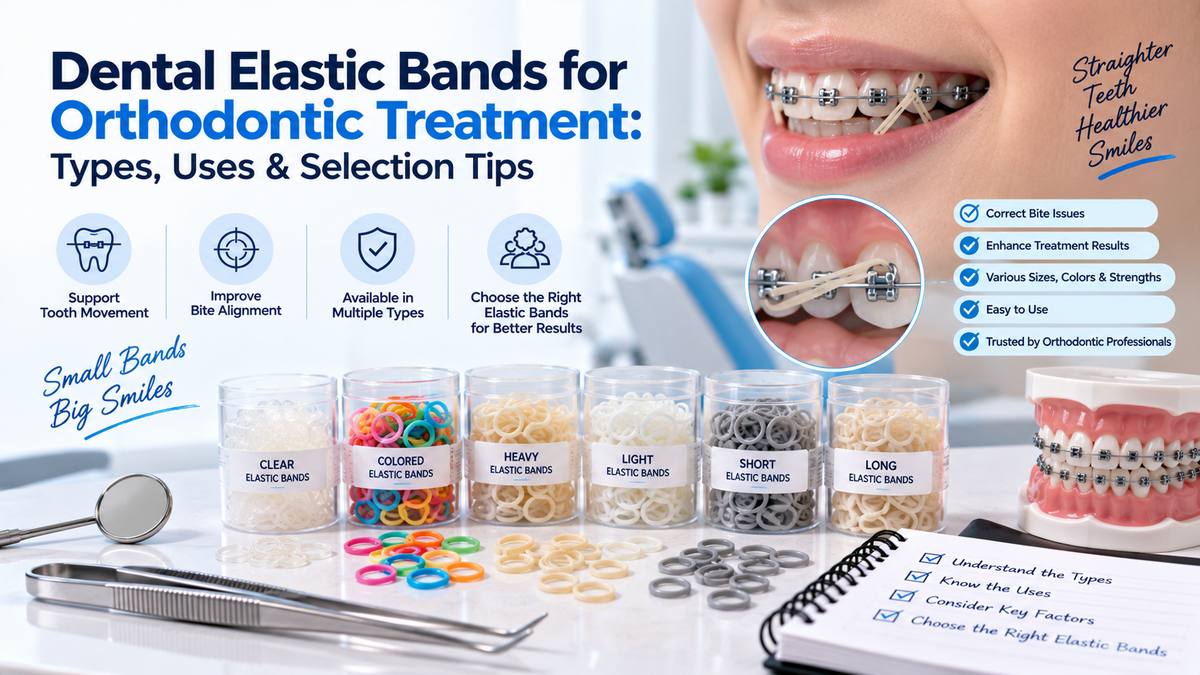
Orthodontic treatment is not limited to brackets, wires, and aligners. In many treatment plans, small elastic bands play an important role in guiding teeth and improving the way the upper and lower arches fit together. Known as orthodontic elastics or intraoral elastics, these bands provide controlled traction between selected teeth, brackets, or attachments.
For dental practices, choosing the appropriate dental elastic bands for orthodontic treatment requires more than simply selecting a size. Material, diameter, force level, configuration, patient requirements, and intended clinical application can all influence product selection.
Modern orthodontic elastics are available in different sizes and force levels, including light, medium, and heavy options. Latex and latex-free varieties are also available, giving practices greater flexibility when treating patients with material sensitivities. Research shows that elastic force decreases during intraoral use, making appropriate replacement and consistent clinical instructions important.
This guide explains the major types of dental elastic bands, their common applications, and practical considerations for selecting them for an orthodontic practice.
What Are Dental Elastic Bands?
Dental elastic bands are small circular elastics designed to produce orthodontic force. Depending on the treatment plan, they may connect brackets or attachments on the same arch or extend between the upper and lower arches.
Unlike ordinary rubber bands, orthodontic elastics are manufactured to specific dimensions and force classifications. Their purpose is to deliver a controlled force in a particular direction.
The American Association of Orthodontists explains that elastics can be attached to selected hooks on upper and lower brackets or other attachment points, with the configuration determined by the desired tooth movement and bite correction.
The exact elastic, attachment points, wear schedule, and force should therefore be selected by the treating dental professional rather than by the patient.
Why Are Orthodontic Elastics Used?
Braces and aligners are highly effective for moving teeth, but certain bite corrections require additional directional forces. This is where elastics become useful.
Common purposes include:
Supporting correction of Class II relationships
Supporting Class III correction
Helping manage crossbites
Improving vertical tooth relationships
Assisting with midline correction
Helping settle the bite toward the finishing stage
Providing additional traction during orthodontic mechanics
Supporting specific tooth or segment movements
Because the position of an elastic determines the direction of its force, even a small change in attachment points can change the biomechanical effect.
For this reason, dental elastic bands should always be selected and prescribed according to the patient's treatment plan.
Main Types of Dental Elastic Bands for Orthodontic Treatment
There is no single elastic that works for every orthodontic situation. Products can be classified by force, material, size, and clinical configuration.
1. Light Orthodontic Elastics
Light elastics generate relatively lower forces and may be useful when gentle traction is appropriate.
They can be considered for applications such as:
Vertical settling
Finishing mechanics
Intercuspation
Selected tooth movements
Certain mild orthodontic corrections
Sky Dental Supply currently lists 2.5 oz light intraoral orthodontic elastics in its intraoral elastics selection.
The appropriate force, however, depends on the treatment mechanics rather than the product label alone.
2. Medium Orthodontic Elastics
Medium elastics provide greater force than light varieties and are commonly used when stronger traction is required.
They may be selected for specific sagittal or other interarch mechanics under professional direction. Current literature describes medium-force elastics around the 3.5–4.5 oz range as commonly used for certain sagittal corrections.
Sky Dental Supply offers 4.5 oz medium intraoral orthodontic elastics in packages of 5,000.
3. Heavy Orthodontic Elastics
Heavy elastics provide a higher nominal force and may be appropriate for treatment situations where stronger traction is specifically prescribed.
Sky Dental Supply lists 6.5 oz heavy intraoral orthodontic elastics as part of its current intraoral elastics range.
More force does not automatically mean faster or better treatment. Excessive or incorrectly positioned elastic force can create unwanted tooth movement. The AAO specifically advises patients not to wear more elastics than prescribed because excessive force can be harmful or interfere with treatment.
Latex vs. Latex-Free Orthodontic Elastics
Material is another important consideration when selecting dental elastic bands for orthodontic treatment.
Latex Elastics
Natural latex has traditionally been widely used for orthodontic elastics because of its elasticity and force characteristics.
Potential advantages include:
Good elastic recovery
Strong initial force
Flexible material
Established use in orthodontic applications
However, latex may not be suitable for every patient. Individuals with known latex sensitivity may require an alternative material.
Latex-Free Elastics
Latex-free orthodontic elastics are generally manufactured from synthetic elastomeric materials. They provide an alternative for patients who should avoid natural rubber latex.
The main reason for selecting latex-free elastics is often biocompatibility and latex sensitivity. Research comparing the two materials indicates that non-latex elastics can experience greater force degradation, so clinicians should consider their mechanical characteristics when planning treatment.
Before selecting an elastic for a patient with a suspected allergy, dental professionals should review the manufacturer's material information and the patient's clinical history.
Understanding Elastic Size
Force is only one part of elastic selection. Diameter also matters.
Orthodontic elastics are available in different internal diameters, and the appropriate diameter depends on the distance between attachment points and the desired biomechanics.
A smaller or larger elastic may produce a different amount of stretch at the same attachment points. Therefore, simply choosing an elastic based on its force classification without considering size can lead to inappropriate mechanics.
Dental practices should maintain commonly prescribed sizes and forces rather than treating all orthodontic elastics as interchangeable.
Common Orthodontic Elastic Configurations
The same elastic can have different effects depending on where it is attached.
Class II Elastics
Class II elastics are generally used to support correction of certain overbite or Class II relationships. They extend between selected upper and lower attachment points to create a forward/backward force relationship.
Class III Elastics
Class III elastics use the opposite general direction of traction and may be incorporated into mechanics for patients with Class III relationships.
Cross Elastics
Cross elastics can be used to address selected transverse discrepancies, including certain crossbite mechanics.
Vertical Elastics
Vertical elastics can assist with bite settling and intercuspation. Triangle, box, and other configurations may be selected according to the desired movement.
Midline or Diagonal Elastics
Diagonal configurations may be incorporated when correcting certain dental midline discrepancies or asymmetries.
These classifications describe general orthodontic applications. The exact attachment points and force must be determined by the treating orthodontist.
How to Select the Right Dental Elastic Bands
Selecting dental elastic bands for orthodontic treatment should involve several considerations.
Consider the Treatment Objective
Start with the intended movement. Is the elastic being used for sagittal correction, vertical settling, transverse correction, or another purpose?
The answer helps determine the appropriate configuration and force.
Check the Required Force
Light, medium, and heavy elastics are not interchangeable. The prescribed force should be based on the treatment mechanics and professional assessment.
Select the Correct Diameter
The distance between attachment points affects elastic activation. Choosing the correct diameter helps ensure that the elastic performs as intended.
Consider Latex Sensitivity
Ask about known latex allergies or sensitivities. When appropriate, select a verified latex-free alternative and follow the manufacturer's specifications.
Review Product Consistency
For a dental practice, consistency matters. Elastics should have clearly identified sizes, force levels, materials, and packaging so that staff can quickly identify the correct product.
Consider Packaging and Inventory
Orthodontic practices use elastics regularly, so bulk packaging can be practical for high-volume treatment environments. It can also simplify inventory management and reduce the frequency of reordering.
Why Elastic Force Changes During Use
Orthodontic elastics do not maintain exactly the same force indefinitely.
Studies have found that intraoral elastics experience force degradation over time, with substantial changes occurring particularly during the early period after stretching. Saliva and intraoral conditions can influence material behavior.
This is why clinicians commonly provide patients with instructions for replacing elastics at appropriate intervals.
Patients should also understand that an elastic that has stretched, broken, or fallen out should not simply be reused. The AAO recommends using fresh elastics and following the orthodontist's specific wearing instructions.
Tips for Dental Practices Managing Orthodontic Elastics
A well-organized elastic inventory can make everyday orthodontic treatment more efficient.
Consider maintaining:
Separate force levels: Keep light, medium, and heavy elastics clearly organized.
Separate sizes: Avoid storing different diameters together without clear labeling.
Material identification: Clearly distinguish latex and latex-free products.
Bulk inventory: For frequently used sizes, larger packages can help prevent supply interruptions.
Proper storage: Follow the manufacturer's storage instructions and protect elastic products from unfavorable environmental conditions.
Staff training: Ensure dental assistants and clinical staff understand the differences between commonly used elastic products.
Patient instructions: Give patients clear directions regarding placement, replacement, and wear time.
Common Mistakes to Avoid
Even a quality orthodontic elastic may not perform as intended if it is used incorrectly.
Some common mistakes include:
Selecting the wrong force
Using the wrong diameter
Confusing latex and latex-free products
Using old or damaged elastics
Reusing single-use elastics
Giving patients unclear wear instructions
Assuming a stronger elastic will produce faster results
Failing to maintain adequate inventory
The AAO emphasizes that patients should use elastics exactly as prescribed and should not add extra elastics independently.
Why Choose Sky Dental Supply for Orthodontic Elastics?
Sky Dental Supply is a dental supply resource offering products for dental practices, including a dedicated intraoral elastics category.
Its current intraoral elastics selection includes:
Light 2.5 oz intraoral orthodontic elastics
Medium 4.5 oz intraoral orthodontic elastics
Heavy 6.5 oz intraoral orthodontic elastics
The listed elastics are available in 5,000-count packages, providing a practical option for orthodontic and dental offices that need to maintain regular stock.
For practices purchasing orthodontic supplies, having different force levels available can make routine inventory management easier. Dental professionals can review the available specifications and select products that match their clinical requirements.
Browse Sky Dental Supply Intraoral Elastics
Frequently Asked Questions
1. What are dental elastic bands used for in orthodontics?
Dental elastic bands provide controlled traction between selected teeth, brackets, or orthodontic attachments. They may support bite correction, vertical settling, crossbite mechanics, or other movements prescribed by an orthodontist.
2. What are the different strengths of orthodontic elastics?
Orthodontic elastics are commonly categorized into light, medium, and heavy force levels. The appropriate level depends on the treatment plan and should be selected by the dental professional.
3. Are latex-free orthodontic elastics available?
Yes. Latex-free elastics are available as an alternative for patients who should avoid natural latex. Dental professionals should verify the material specifications before selecting a product for a patient with latex sensitivity.
4. Can patients use stronger elastics to speed up treatment?
No. Patients should never increase elastic strength or wear additional elastics unless instructed by their orthodontist. Excessive force can cause unwanted effects and may interfere with treatment.
5. How often should orthodontic elastics be replaced?
Replacement schedules vary according to the product and treatment plan. Because elastics lose force during use, patients should follow the replacement instructions provided by their orthodontist.
6. Does the size of an orthodontic elastic matter?
Yes. Diameter affects how an elastic stretches between attachment points and therefore influences the force delivered. Size should be selected according to the prescribed orthodontic mechanics.
7. Where can dental practices buy orthodontic elastics?
Dental practices can source orthodontic elastics through dental supply companies such as Sky Dental Supply. Its current intraoral elastics category includes light, medium, and heavy options in bulk packaging.
Final Thoughts
The right dental elastic bands for orthodontic treatment can be an important part of an effective orthodontic supply system. However, choosing the right product involves more than selecting the strongest available band. Force, diameter, material, attachment configuration, patient needs, and treatment objectives all need to be considered.
For dental practices, maintaining a well-organized selection of commonly used elastics can support efficient clinical workflows and help ensure that prescribed products are readily available. By understanding the differences between light, medium, and heavy elastics, as well as latex and latex-free options, dental professionals can make more informed purchasing decisions.
With its dedicated intraoral elastics category and multiple force options, Sky Dental Supply provides dental practices with convenient access to essential orthodontic elastic products. The final product and clinical application should always be determined by the treating dental professional based on the patient's individual treatment requirements.