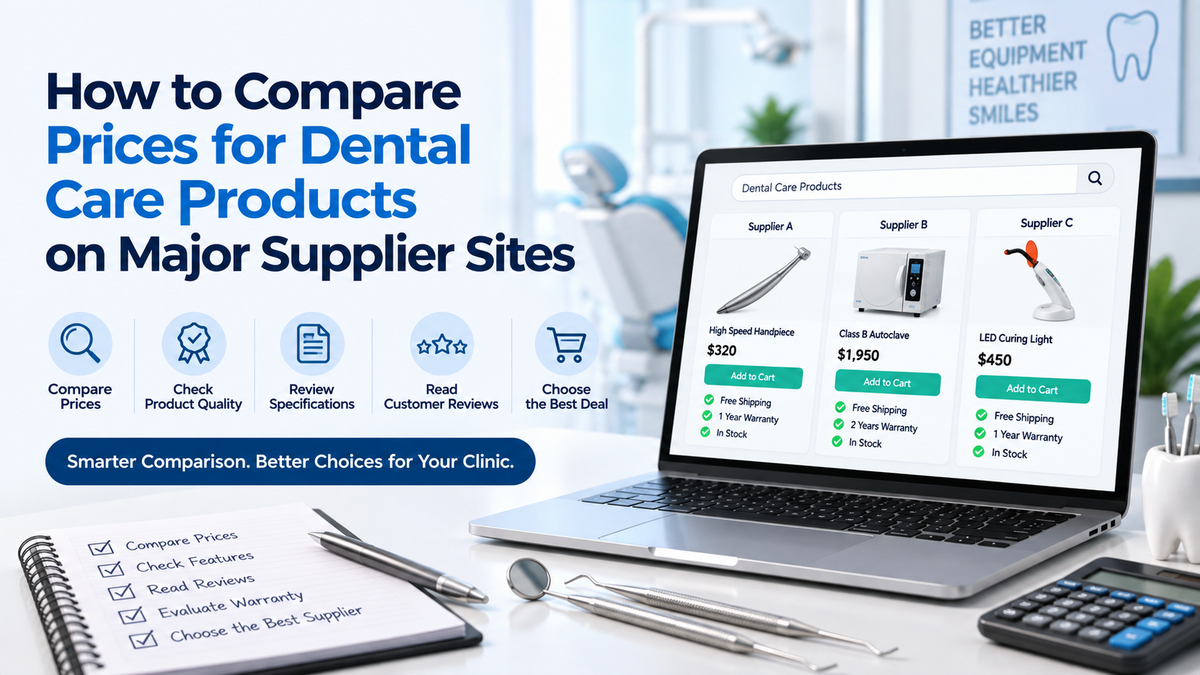
Buying dental care products is one of the most important purchasing responsibilities for a dental practice. From diagnostic instruments and periodontal tools to restorative products and surgical instruments, clinics need a reliable supply of products without unnecessarily increasing their operating costs. With so many dental suppliers selling similar products, comparing prices before placing an order can help practices make more informed purchasing decisions.
However, comparing dental products is not always as simple as choosing the lowest number on a product page. Different suppliers may offer different brands, pack sizes, shipping charges, discounts, promotions, or account-based pricing. A product that appears cheaper initially may cost more after shipping or may contain fewer instruments than another option.
That is why dental practices should use a structured approach when comparing prices. This guide explains how to compare dental care products across major supplier websites and how a supplier such as Sky Dental Supply can fit into a cost-conscious purchasing strategy.
Why Price Comparison Matters for Dental Practices
Dental practices purchase supplies regularly, which means even small differences in product prices can become significant over time. If an office purchases the same instruments, consumables, or accessories every month, comparing prices can help identify opportunities to reduce purchasing costs.
Online dental purchasing has also made comparison easier. Some platforms are specifically designed to compare prices between distributors, while individual supplier websites allow practices to review their catalogs and product specifications. Price-comparison platforms can show multiple supplier prices side by side, while direct supplier websites may provide promotions, negotiated pricing, and product information that comparison sites do not always capture.
For example, Sky Dental Supply currently lists more than 1,100 products in its dental instruments category, including diagnostic instruments, hygiene tools, operative instruments, surgical instruments, instrument cassettes, and related products.
Start by Identifying the Exact Product
The first step in comparing prices is to make sure you are comparing the same product.
Dental instruments can look similar while differing considerably in design, manufacturer, material, handle style, size, or intended application. Searching only for a general term such as “dental curette” may produce dozens of options.
Instead, record the following information before comparing prices:
Product name
Manufacturer or brand
Manufacturer item number or SKU
Instrument size
Single-ended or double-ended design
Quantity or package size
Material
Product specifications
Intended clinical application
Using the manufacturer name and item number is particularly useful when comparing products across several websites. It reduces the possibility of comparing two similar-looking products that are actually different.
Compare Product Specifications, Not Just Prices
A lower price does not automatically mean a better deal.
Suppose one supplier sells an instrument for $20 and another sells a similar-looking instrument for $28. If the $28 instrument uses a different material, has a specialized handle, or comes from a manufacturer preferred by the dental professional, the price difference may be justified.
This is especially important for instruments that are used frequently. Diagnostic, operative, periodontal, and surgical instruments need to meet the requirements of the procedure for which they are intended.
Sky Dental Supply's dental instrument catalog includes products from recognized manufacturers and brands such as Hu-Friedy, PDT, Premier, J&J Instruments, American Eagle, and others.
The goal should therefore be to compare equivalent products, rather than simply finding the lowest advertised price.
Check the Price Per Unit
Package size is another factor that can make price comparisons misleading.
One supplier may sell a product individually while another sells a pack of five or ten. Comparing the total price without calculating the unit cost can result in an inaccurate purchasing decision.
For example:
Supplier A: $50 for 5 instruments
Supplier B: $72 for 10 instruments
Supplier A appears cheaper at first, but the unit prices are:
Supplier A: $10 per instrument
Supplier B: $7.20 per instrument
The second option provides the lower unit cost.
This approach is particularly helpful when purchasing instrument accessories, cassettes, code rings, disposable products, or products sold in multiple quantities.
Compare Multiple Brands at the Same Time
Sometimes the best way to control costs is not to find the cheapest supplier for one particular brand, but to compare equivalent brands.
For example, Sky Dental Supply's operative category includes burnishers and other instruments from several manufacturers at different price points. Current listings show examples such as a Premier burnisher at $29.99, a PDT burnisher at $39.99, an American Eagle burnisher at $48.99, and certain Hu-Friedy models at higher prices.
This illustrates why a dental practice should consider both brand and clinical requirements when evaluating price.
If a dentist specifically requires a particular manufacturer or model, compare that exact item across suppliers. If there is flexibility, compare equivalent products from multiple reputable brands and evaluate price, quality, design, durability, and user preference together.
Look Beyond the Listed Product Price
The displayed product price is only one part of the total purchasing cost.
Before completing an order, check:
Shipping Costs
A supplier offering a lower product price may charge more for delivery. Another supplier may have free or discounted shipping based on order value.
Minimum Order Requirements
Some suppliers may offer promotions or discounts that require a minimum purchase amount.
Taxes and Other Charges
Depending on the buyer's location and the supplier's policies, taxes and other charges can affect the final total.
Promotional Discounts
Dental suppliers frequently offer special pricing, clearance items, seasonal promotions, or quantity discounts. Check whether the listed price is a promotional price and how long it remains available.
Availability
A low-priced product is not necessarily a good deal if it is unavailable when your practice needs it. Delivery time and stock availability should be considered alongside price.
Industry purchasing resources also recommend looking at shipping policies and delivery commitments rather than focusing exclusively on product pricing.
Compare Prices Across Major Dental Supplier Websites
A practical price comparison process can include several types of sources.
Large Dental Distributors
Major dental distributors generally offer broad product catalogs covering instruments, equipment, infection control, restorative materials, pharmaceuticals, and other clinical supplies.
These websites are useful when a practice wants to consolidate purchases with one supplier. However, registered customers may receive account-specific or negotiated pricing, so the public price shown online may not always represent the final price available to a particular practice.
Specialized Dental Suppliers
Specialized suppliers can be useful for particular categories such as dental instruments, orthodontic products, surgical instruments, or infection-control products.
These suppliers may have a narrower focus and can make it easier to find specific products.
Dental Price-Comparison Platforms
Dedicated comparison services can simplify the process by displaying prices from multiple suppliers. Some platforms are designed to show supplier pricing side by side, allowing practices to identify differences without opening numerous websites.
However, always verify the final price directly with the supplier before purchasing, particularly when comparison information may not include shipping, promotions, negotiated account pricing, or current inventory.
Create a Simple Comparison Sheet
A spreadsheet can make recurring purchasing decisions much easier.
For each product, record:
Comparison Factor | What to Record |
Product | Exact product name |
Brand | Manufacturer |
SKU | Manufacturer or supplier item number |
Quantity | Units per package |
Supplier Price | Listed product price |
Unit Cost | Price divided by quantity |
Shipping | Delivery cost |
Final Cost | Product + shipping + applicable charges |
Availability | In stock/out of stock |
Delivery | Estimated delivery timeframe |
Promotion | Discount or special offer |
Notes | Warranty, specifications, or other details |
This method makes it easier to identify which supplier offers the best overall value, rather than simply the lowest sticker price.
Use Sky Dental Supply as One of Your Comparison Points
Sky Dental Supply Dental Instruments can be a useful starting point for practices researching dental instruments online.
Its dental instruments section includes a broad selection covering hygiene, diagnostic, operative, endodontic, surgical, and other instrument categories. The current catalog includes examples such as a PDT #5 stainless-steel mouth mirror listed at $7.99, an Abbey needle holder listed at $14.99, an Akro-Flex composite instrument at $67.99, and various instrument accessories.
Sky Dental Supply also provides specialized categories for areas such as perio and hygiene, where shoppers can find scalers, curettes, periodontal instruments, and related products.
Another consideration is the supplier's stated 100% Price Match Guarantee, which appears on its site. Practices should review the applicable terms and conditions to understand how price matching works before making a purchasing decision.
The benefit of using Sky Dental Supply in your comparison process is that you can review a broad dental instrument catalog and compare specific models, brands, and prices against other supplier websites.
Compare Frequently Purchased Products First
Not every item needs to be compared every time you place an order.
Start with products that your practice purchases frequently or in large quantities. These may include:
Dental examination instruments
Scalers and curettes
Dental mirrors
Restorative instruments
Surgical instruments
Instrument cassettes
Instrument accessories
Infection-control products
Dental burs
Orthodontic supplies
For frequently purchased products, even a small unit-price difference can create meaningful savings over a year.
For example, if a practice saves $3 per unit on an instrument and purchases 20 units each month, the annual difference would be $720. The actual savings will vary according to purchasing volume, supplier pricing, promotions, and shipping costs, but the example demonstrates why recurring purchases deserve attention.
Consider Quality and Durability
Price comparison should never mean choosing poor-quality products simply because they cost less.
For reusable dental instruments, consider:
Stainless-steel quality
Handle design
Instrument balance
Precision
Manufacturer reputation
Sharpening requirements
Sterilization compatibility
Expected service life
Warranty or replacement policies
A cheaper instrument that needs frequent replacement may ultimately cost more than a higher-quality instrument that performs reliably for a longer period.
The same principle applies to other dental products. Purchasing decisions should balance price with clinical performance and total ownership cost.
Evaluate Supplier Service
A dental supplier is more than an online product catalog.
When comparing suppliers, consider whether the company offers:
Responsive customer support
Easy online ordering
Clear product information
Order tracking
Reliable fulfillment
Returns or replacement policies
Price matching
Professional assistance
Convenient account management
These services can save staff time and reduce purchasing complications.
For a busy dental practice, a slightly higher product price may sometimes be worthwhile if the supplier provides better service, dependable fulfillment, or easier ordering.
Review Your Purchasing Decisions Regularly
Dental supply pricing can change. Promotions expire, manufacturers update products, and suppliers may introduce new pricing.
Instead of comparing prices only when something seems expensive, make price reviews part of your purchasing routine.
A practice can review its top 20 or 30 frequently purchased products every few months. Compare the current supplier price against alternative suppliers and check whether the product specifications remain identical.
This creates a more consistent purchasing strategy and can help prevent unnecessary overspending.
A Smarter Way to Compare Dental Product Prices
The most effective price comparison process combines several factors:
Exact product + quantity + unit price + shipping + availability + quality + supplier service = true purchasing value
This approach prevents practices from making decisions based solely on the lowest advertised number.
Online dental purchasing has become increasingly convenient, with comparison platforms and large supplier catalogs making it easier for practices to research alternatives. At the same time, established suppliers such as Sky Dental Supply provide extensive product selections that can be reviewed directly when comparing dental instruments and other practice supplies.
For dental offices looking to control purchasing costs, the objective is not necessarily to buy the cheapest product. It is to identify the right product at a competitive total cost from a dependable supplier.
Frequently Asked Questions
1. Why should dental practices compare supplier prices?
Comparing supplier prices can help dental practices identify better purchasing opportunities, especially for products they order frequently. It also allows practices to compare brands, package quantities, shipping costs, and promotions before purchasing.
2. Should I always choose the lowest-priced dental instrument?
No. The lowest price does not necessarily represent the best value. Consider product quality, manufacturer, specifications, durability, clinical requirements, shipping, and supplier service before making a decision.
3. How can I compare the same dental product across suppliers?
Use the manufacturer's name, exact product name, SKU or item number, size, and package quantity. These details help ensure that you are comparing identical products rather than similar-looking alternatives.
4. Does Sky Dental Supply sell dental instruments?
Yes. Sky Dental Supply offers a large dental instruments catalog covering categories such as diagnostics, operative instruments, perio and hygiene, surgical instruments, trays, cassettes, and instrument-care products.
5. Does Sky Dental Supply offer price matching?
Sky Dental Supply currently displays a 100% Price Match Guarantee on its website. Customers should review the supplier's current terms and conditions to determine eligibility for a specific product or competing price.
6. What is the most important factor when comparing dental product prices?
The most important factor is the total cost for an equivalent product. Include the product price, quantity, shipping, applicable charges, promotions, and other purchasing conditions rather than comparing the advertised price alone.
7. How often should a dental practice review supplier pricing?
Practices can review pricing periodically, particularly for high-volume and frequently purchased products. Regular reviews can help identify changes in supplier pricing and new purchasing opportunities.
8. Can I compare different dental instrument brands?
Yes, when the clinical requirements allow alternatives. Compare specifications, materials, ergonomics, manufacturer reputation, durability, and price to determine which option provides the best overall value.
Final Thoughts
Comparing prices for dental care products does not have to be complicated. Start by identifying the exact product, compare equivalent specifications, calculate the unit cost, include shipping and other charges, and evaluate quality and supplier service.
For dental instruments specifically, reviewing a broad catalog such as the one offered by Sky Dental Supply can give practices another useful reference point when researching products and prices. Its online dental instruments collection includes products from multiple manufacturers and categories, giving dental professionals plenty of options to evaluate.
By making price comparison part of your regular purchasing process, your practice can make more confident buying decisions while keeping quality and patient care at the center of every purchase.