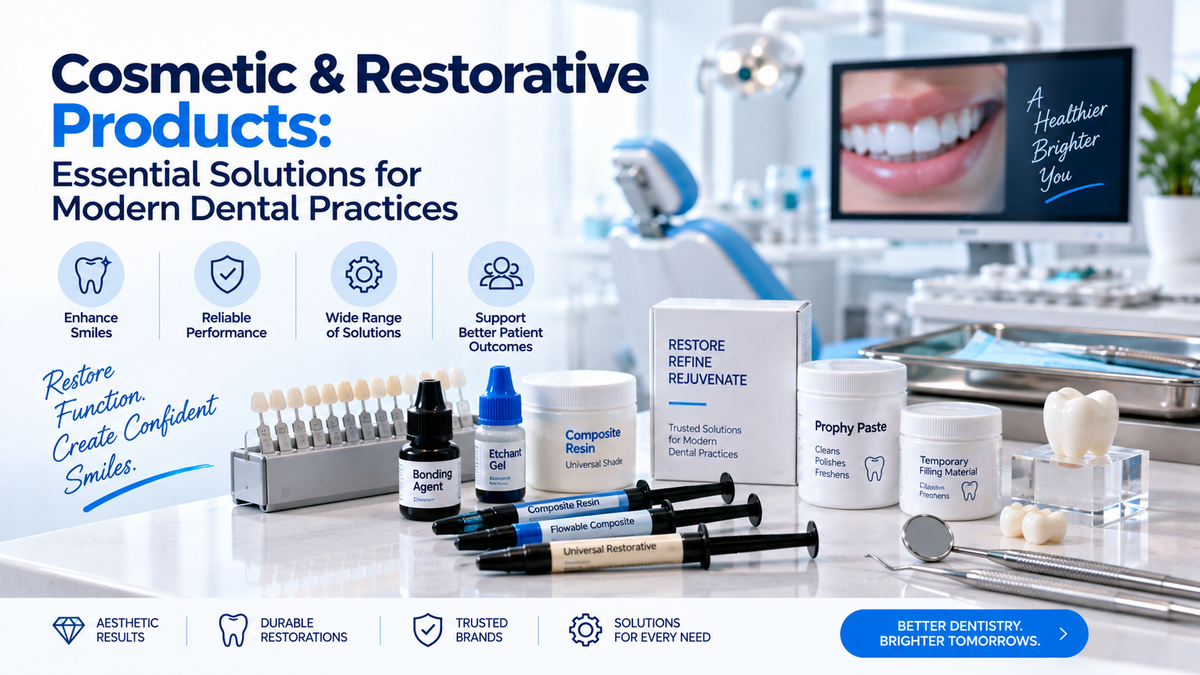
Modern dentistry is no longer focused only on treating dental problems. Patients increasingly want restorations that restore function while also looking natural and blending comfortably with their existing teeth. From repairing a small cavity to rebuilding a damaged tooth, the right combination of cosmetic & restorative products can make a significant difference in clinical outcomes and patient satisfaction.
For dental practices, choosing restorative materials is about more than simply keeping commonly used products on the shelf. Dentists need materials that fit different clinical situations, offer predictable handling, support efficient workflows, and deliver the aesthetic results patients expect.
Today’s dental supply market includes a wide selection of composites, bonding systems, etchants, cements, impression materials, finishing products, curing lights, and other restorative essentials. Understanding how these products work together can help practices create an efficient restorative workflow.
What Are Cosmetic & Restorative Dental Products?
Cosmetic and restorative dental products are materials and instruments used to repair, rebuild, reshape, or improve the appearance of teeth.
Restorative dentistry generally focuses on restoring teeth affected by decay, fractures, wear, or structural damage. Cosmetic dentistry places greater emphasis on appearance, including tooth color, shape, symmetry, and surface finish. In many modern procedures, these two objectives overlap.
For example, a composite restoration may be used to repair a damaged tooth while also matching the surrounding enamel. The American Dental Association identifies resin-based composites, glass ionomers, resin-modified glass ionomers, and other materials among the options used for direct restorative applications.
The appropriate product depends on the tooth, location, required strength, moisture conditions, aesthetic expectations, and the dentist’s preferred technique.
Why Material Selection Matters in Restorative Dentistry
A restoration is only as effective as the materials and technique used to place it. Even highly advanced products need to be selected and handled according to their intended applications.
Material selection can influence several aspects of treatment:
Appearance of the completed restoration
Bonding performance
Handling and working time
Ease of placement
Resistance to wear and fracture
Finishing and polishing requirements
Radiographic visibility
Overall workflow efficiency
For example, resin composites are popular because they can provide tooth-colored restorations and are available in different formulations and viscosities. Glass ionomer materials offer different properties and can be useful in appropriate clinical applications. The ADA notes that restorative materials differ in their indications, strengths, limitations, and aesthetic characteristics.
The goal is not to find one material for every procedure. Instead, practices should maintain a well-planned selection that supports the procedures they routinely perform.
Essential Cosmetic & Restorative Products for Dental Practices
1. Dental Composite Materials
Composite resin is one of the most recognizable materials in modern restorative dentistry. Its tooth-colored appearance makes it particularly useful when aesthetics are important.
Composites are available in different shades, viscosities, filler technologies, and delivery formats. Depending on the product and clinical indication, dentists may use them for anterior or posterior restorations, cosmetic reshaping, repairs, and other applications.
Sky Dental Supply currently lists products such as Nano-Hybrid Composite 4g Syringes and Nano-Hybrid Composite Unidose options, giving practices access to restorative composite formats for different workflows.
2. Dental Bonding Agents
A successful composite restoration requires appropriate adhesion between the restorative material and tooth structure. Bonding systems are therefore an important part of many restorative workflows.
Depending on the system, dental adhesives may involve different etching and application steps. Dentists should always follow the manufacturer's instructions for preparation, application, curing, and compatibility.
Choosing a bonding system that fits the practice's preferred restorative technique can help make procedures more consistent.
3. Etching Materials
Etchants are commonly used as part of adhesive restorative procedures. They help prepare the tooth surface before bonding.
Sky Dental Supply offers 37% Phosphoric Acid Etch Gel, which is an example of an etching product used within restorative workflows.
Because surface preparation is an important part of adhesive dentistry, proper application and isolation are essential. Product instructions should always be followed carefully.
4. Curing Lights
Light-cured restorative materials require an appropriate curing process. A dental curing light therefore becomes an important piece of equipment when a practice regularly uses light-activated composites, bonding materials, or related products.
Sky Dental Supply lists both 5th Generation 1-Step Bonding Light Cure and 7th Generation Self-Etching Bonding Light Cure products within its product selection.
When selecting curing equipment, practices should consider factors such as compatibility, curing performance, battery operation, ergonomics, and maintenance requirements.
5. Glass Ionomer and Resin-Modified Materials
Glass ionomer materials occupy an important place in restorative dentistry because they have characteristics that differ from conventional resin composites. They can be used for selected restorative, lining, cementation, and other applications depending on the formulation.
Resin-modified glass ionomers combine components of traditional glass ionomer chemistry with resin technology. The ADA notes that these materials can offer different handling and mechanical characteristics compared with conventional glass ionomers.
The correct choice should be based on the intended indication rather than simply selecting a material because it is popular.
6. Core Build-Up Materials
When a tooth has experienced significant structural loss, rebuilding the foundation may be an important step before definitive restoration.
Core build-up materials are designed for appropriate applications where additional tooth structure needs to be reconstructed. Sky Dental Supply currently lists a Core Build-Up Material 50ml Cartridge among its restorative-related products.
Practices should consider cartridge compatibility, dispensing systems, working time, curing requirements, and handling characteristics when selecting these materials.
7. Dental Impression Materials
Accurate records are important for many restorative procedures. Impression materials can be used when the clinical workflow requires a physical impression.
Vinyl polysiloxane, commonly called VPS, is one category of impression material used in dentistry. Sky Dental Supply lists VPS Vinyl Polysiloxane Impression Material as well as VPS putty products.
For practices using conventional impression workflows, maintaining the appropriate trays, dispensing accessories, and impression materials can help keep procedures organized.
8. Finishing and Polishing Products
Restoration placement is not necessarily the final step. Proper finishing and polishing can help refine contours and surface appearance according to the material and clinical technique.
Polishing stones, discs, points, and other finishing products may be used at different stages. Sky Dental Supply lists products including White Polishing Stones and Green Polishing Stones in its Sky Choice range.
A well-organized polishing system allows dental teams to select the appropriate product for the restoration being treated.
Cosmetic Dentistry Requires More Than Tooth-Colored Materials
A common misconception is that cosmetic dentistry simply means using white restorative materials. In reality, achieving a natural-looking result involves several factors.
Shade selection, translucency, anatomy, surface texture, contour, finishing, and polishing can all influence the final appearance. The restorative material is only one part of the process.
This is why a practice may need several complementary products rather than relying on a single composite or bonding system.
The ADA also highlights that restorative materials differ in properties such as strength, aesthetics, wear characteristics, and clinical indications.
How to Choose Cosmetic & Restorative Products
Dental practices can use several criteria when evaluating products for their inventory.
Consider the Clinical Application
Start with the procedure. A material intended for a specific indication may not be appropriate for another situation. Always review manufacturer guidance and applicable clinical recommendations.
Evaluate Handling
Dentists and assistants work under time constraints. Products with handling characteristics that suit the practice's workflow can help improve consistency.
Check Compatibility
Adhesives, composites, curing equipment, dispensing systems, and other components may need to work together. Product compatibility should be confirmed before introducing a new system.
Think About Inventory Management
Buying too many similar products can create unnecessary inventory costs. Practices can instead identify their most common procedures and maintain products that cover those needs efficiently.
Compare Quality and Value
Price matters, but the lowest purchase price is not necessarily the lowest overall cost. Practices should consider usability, waste, shelf life, consistency, and performance when evaluating restorative products.
Building a More Efficient Restorative Workflow
A streamlined restorative setup can make it easier for dental teams to prepare for procedures.
A typical workflow may involve:
Diagnosis → Tooth preparation → Isolation → Etching/conditioning → Bonding → Restorative material placement → Curing → Finishing → Polishing → Occlusal evaluation
The exact sequence varies depending on the procedure and materials being used. Manufacturers' instructions should always take priority.
Keeping commonly used materials together can also reduce unnecessary interruptions. For example, a restorative setup may include composite, bonding agent, etchant, curing light, finishing instruments, polishing products, articulating paper, and other accessories.
Why Dental Practices Should Work With a Reliable Supplier
A reliable supplier can make dental inventory management easier by providing access to multiple categories from one source.
Instead of purchasing every item separately from different vendors, practices can build relationships with suppliers that offer restorative materials alongside other dental supplies and equipment.
This can simplify ordering, product comparison, replenishment, and account management.
Why Choose Sky Dental Supply?
Sky Dental Supply provides dental materials, supplies, equipment, pharmaceuticals, orthodontic products, and other products for dental practices. The company states that it focuses on customer service, competitive pricing, free shipping, and fast delivery.
Its catalog includes products relevant to restorative workflows, including nano-hybrid composites, etching gel, bonding and curing products, core build-up material, VPS impression materials, and polishing products.
Sky Dental Supply also features products from manufacturers such as GC America, Hu-Friedy, Kerr, Solventum (3M), Ivoclar, and Air Techniques.
For dental offices looking to organize purchasing across multiple categories, having access to restorative materials alongside broader dental supplies can make routine procurement more convenient.
Practices can explore the current catalog and product availability directly through Sky Dental Supply.
The Future of Cosmetic and Restorative Dentistry
Restorative dentistry continues to evolve as materials and digital technologies improve. Newer materials increasingly aim to balance aesthetics, handling, strength, and workflow efficiency.
Digital dentistry is also changing how some indirect restorations are designed and fabricated. The ADA notes that advances in CAD/CAM technology have blurred some of the traditional distinctions between direct and indirect restorative workflows.
For dental practices, staying current does not mean replacing every product whenever a new material becomes available. Instead, it means evaluating new technologies carefully and determining whether they provide meaningful benefits for the procedures performed in the practice.
Final Thoughts
Cosmetic and restorative dentistry depends on a combination of materials, equipment, technique, and clinical judgment. From composites and bonding agents to etchants, curing lights, impression materials, core build-up products, and polishing systems, each component can contribute to an efficient restorative workflow.
A carefully selected inventory helps dental teams prepare for different clinical needs while avoiding unnecessary duplication. Working with a dependable supplier can make that process even easier.
For practices looking for a broad selection of dental materials and supplies, Sky Dental Supply offers products across multiple categories and continues to provide restorative and cosmetic solutions for modern dental workflows.
Frequently Asked Questions
1. What are cosmetic and restorative dental products?
Cosmetic and restorative dental products include materials and supplies used to repair, rebuild, reshape, or improve the appearance of teeth. Examples include composite resins, bonding agents, etchants, cements, impression materials, and polishing products.
2. What is dental composite used for?
Dental composite is a tooth-colored restorative material commonly used for selected fillings, repairs, reshaping, and aesthetic restorations. The appropriate product depends on the clinical indication and manufacturer's recommendations.
3. Why are bonding agents used in restorative dentistry?
Bonding agents help create adhesion between tooth structure and restorative materials in procedures where an adhesive technique is indicated. Application requirements vary by product.
4. What is the purpose of dental etching gel?
Etching gel is used to condition tooth surfaces as part of certain adhesive restorative procedures. The exact technique depends on the adhesive system and manufacturer's instructions.
5. What products are available from Sky Dental Supply for restorative procedures?
Sky Dental Supply's current catalog includes products such as nano-hybrid composites, phosphoric acid etch gel, bonding/curing products, core build-up material, VPS impression materials, and polishing stones. Product availability can change over time.
6. How should a dental practice choose restorative materials?
Practices should consider the intended clinical application, material properties, handling characteristics, compatibility, aesthetics, workflow requirements, manufacturer instructions, and overall value when selecting restorative products.
7. Are cosmetic dental products only used for aesthetic procedures?
No. Many materials can serve both functional and aesthetic purposes. For example, tooth-colored restorative materials may be selected to repair damaged tooth structure while also providing a natural-looking appearance.
8. Why is finishing and polishing important?
Finishing and polishing can help refine the contour and surface of a restoration. The appropriate technique and product depend on the restorative material and clinical procedure.