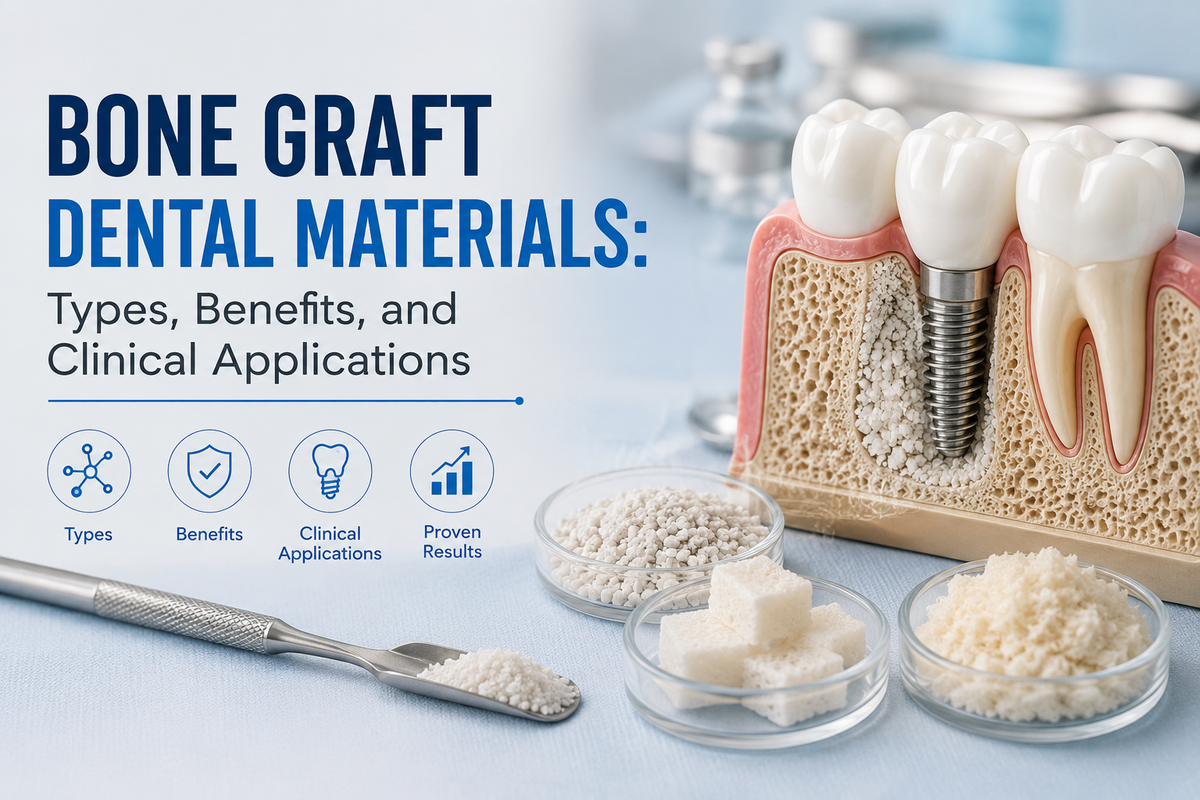
A lot of implant work quietly depends on something that happens well before the implant itself goes in, making sure there's enough bone there to actually support it. Bone disappears for a bunch of reasons, pulled teeth, gum disease, an old injury, or just years of a gap sitting empty, and once there's not enough left, placing an implant gets a lot trickier.
Dentistry's gotten a lot better at rebuilding that lost bone over the years, which means clinicians can plan implant cases with real confidence instead of hoping for the best. Picking the right bone graft dental material really comes down to the patient in front of you, what the treatment's aiming for, and how the surgery's actually laid out.
At Sky Dental Supply, we stock a solid range of grafting materials used across implantology, oral surgery, and regenerative work, built to help clinicians land consistent results case after case.
So What Is Bone Grafting, Actually?
It's a procedure meant to rebuild missing jawbone. Think of the graft as scaffolding, it holds the shape and volume of the jaw steady while new bone forms around it. Dentists usually bring this up before placing an implant, right after pulling a tooth, during a sinus lift, or when repairing bone damage from disease or an accident. Healing's gotten faster and more predictable with newer techniques, which is a big part of why grafting's just routine now in implant dentistry.
Why Does This Actually Matter So Much?
Healthy bone's really the foundation everything else gets built on. Once bone volume starts dropping, real problems follow, not enough support for an implant, facial structure shifting over time, dentures that don't sit right, a higher shot at implant failure, and jawbone that keeps wearing down the longer it's ignored. The right bone graft dental material helps rebuild what's gone and gives future treatment something stable to work with.
What Actually Causes This Bone Loss?
Knowing the cause helps point toward the right fix. Tooth loss is the big one, once a tooth's gone, the bone around it stops getting stimulated by chewing and starts shrinking. Gum disease eats away at supporting bone slowly, leaving gaps that usually need regenerative work. Trauma from an accident can leave fractures or localized damage needing reconstruction. Some congenital conditions affect jaw development from the start. And years of wearing dentures tends to cause slow bone resorption that creeps up without anyone noticing right away.
What Are the Main Bone Graft Options?
Autografts pull bone straight from the patient's own body, usually the chin, ramus, or hip for bigger reconstructions. Great biocompatibility, living bone cells, strong regenerative potential, zero disease transmission risk. The catch is a second surgical site, longer procedure, more discomfort. Still, autografts remain the gold standard for a lot of complex cases.
Allografts come from processed human donor bone, sourced from certified tissue banks and put through serious sterilization and screening. No second site needed, quicker procedure, handles well, and it's widely used for implant prep. A lot of specialists reach for this bone graft dental material specifically because it performs so predictably.
Xenografts come from animal sources, usually bovine bone, purified down until just the mineral structure's left. Solid scaffold for new bone, resorbs slowly, holds ridge volume well, works great for socket preservation. Honestly one of the most commonly used graft materials in implant dentistry right now.
Synthetic grafts are made in a lab to mimic natural bone, hydroxyapatite, beta-tricalcium phosphate, biphasic calcium phosphate, bioactive glass. Unlimited supply, no disease risk, consistent quality, good biocompatibility. A lot of clinicians lean toward this bone graft dental material for how predictably it handles.
How Does the Graft Actually Heal Once It's In?
Materials differ, but the general process looks similar across the board. The graft fills the defect and stabilizes things first. Blood vessels start growing in around it, feeding the healing process. The graft acts as scaffolding, pulling bone-forming cells into the area. New bone slowly regenerates and fuses with the graft. Once healing's far enough along, the implant can finally go in.
Where Does This Actually Come Up in Practice?
Implant site development uses grafting to build up enough volume for a stable placement. Socket preservation right after an extraction limits bone loss and keeps ridge shape intact. Sinus lifts add height beneath the maxillary sinus so implants become possible where they otherwise wouldn't be. Ridge augmentation rebuilds horizontal or vertical defects. Periodontal regeneration supports bone around teeth damaged by gum disease. And peri-implant defect repair fixes bone issues around implants that've run into trouble.
How Do You Actually Land on the Right Material?
A few things weigh in here. Patient health matters a lot, medical history and healing capacity shape the whole plan. Defect size matters too, a small socket needs something different than a big ridge defect. Surgical approach plays in, some grafts suit guided bone regeneration better, others fit sinus augmentation better. How fast bone needs to rebuild affects the choice too. And whether it's immediate or delayed implant placement changes what graft makes sense. Experienced clinicians really do weigh all of it per case rather than defaulting to one material.
Does Quality Actually Change the Outcome?
Yes, genuinely. Better materials support more predictable bone formation, which leads to steadier implant stability once there's enough volume. They tend to cut down on complications too, and holding ridge contours properly leads to results that look more natural. All told, that adds up to implants that hold up better long term.
What Makes a Graft Material Actually Good?
Dental professionals generally want strong biocompatibility, easy handling, good volume stability once placed, controlled resorption, properties that actually encourage bone growth, real sterility, consistent performance, and even particle size. All of it together makes surgery smoother and outcomes more predictable.
Do Membranes Actually Matter Alongside This?
They do, quite a bit. Grafts often get paired with collagen membranes during guided bone regeneration, and the membrane protects the graft, keeps soft tissue out, holds stability, and supports steadier healing. Pairing grafts with a membrane tends to genuinely improve success rates.
Why Buy Bone Graft Dental Material From Sky Dental Supply?
Reliable results start with reliable products. Sky Dental Supply carries a carefully picked range of regenerative materials built for modern implant work. Quality products, trusted implantology solutions, fair pricing, stock you can count on, quick processing, and support that actually knows this space, whether you're general practice, oral surgery, or implant-focused.
What Actually Drives a Good Grafting Outcome?
Picking the right material's only one piece. Accurate diagnosis matters just as much, along with real treatment planning, proper case selection, sterile technique throughout, careful handling of the flap, stable graft placement, the right membrane coverage, consistent follow-up, and honestly, the patient actually sticking to aftercare instructions. Good surgical fundamentals paired with quality material is really what drives good regenerative outcomes.
Final Thoughts
Bone regeneration's genuinely opened up implant treatment for patients who once just didn't have enough bone to work with. The range of options available now lets clinicians tailor treatment per patient while still landing predictable results.
Choosing the right bone graft dental material is really one of the bigger decisions in regenerative dentistry. Autografts, allografts, xenografts, synthetic options, whichever fits, quality materials feed directly into stronger bone formation, better implant stability, and results that actually last.
At Sky Dental Supply, the goal's giving dental professionals regenerative solutions they can genuinely trust, supporting care that leads to real outcomes for patients.
Frequently Asked Questions
What is bone graft dental material?
A regenerative material used to rebuild lost jawbone, giving proper support for implants or other restorative work.
When is bone grafting actually needed?
Usually after an extraction, before implant placement, during sinus lift surgery, or to repair damage from gum disease or trauma.
What are the main types of bone graft materials?
Autografts, allografts, xenografts, and synthetic bone graft materials.
How long does healing actually take?
Usually 3 to 6 months, depending on graft type, defect size, and the patient's overall health.
Is bone grafting actually painful?
Done under local anesthesia or sedation, most patients feel only mild discomfort, manageable with prescribed medication.
Can implants go in right after grafting?
Sometimes, yes, but a lot of cases need healing time first.
Are synthetic graft materials actually safe?
Yes, quality synthetic materials are biocompatible, sterile, and widely used in modern implant dentistry.
How do dentists actually pick the right material?
Comes down to bone loss severity, treatment goals, surgical approach, healing needs, and the patient's medical history.
Why buy bone graft dental material from Sky Dental Supply?
Premium regenerative products, dependable quality, fair pricing, and reliable service built to support successful implant and grafting work.