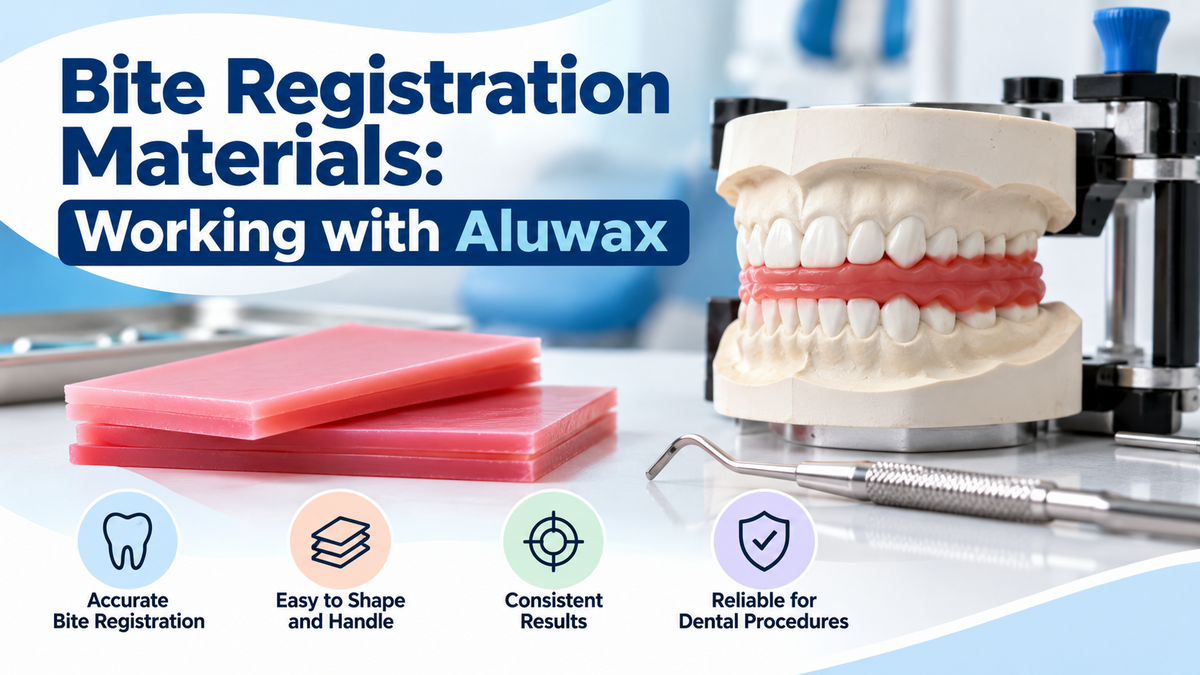
An accurate bite registration is one of the most important records in restorative and prosthodontic dentistry. Even a well-made impression can lead to problems if the relationship between the upper and lower arches is not captured correctly. Occlusal records help the dental laboratory understand how the arches relate to one another and provide a reference for fabricating restorations, appliances, dentures, and other indirect dental work.
Aluwax bite registration wax remains a practical option for many dental procedures. It is easy to soften, adapt, trim, and adjust, making it useful when clinicians need a workable material for recording the relationship between opposing arches. At the same time, modern PVS bite registration materials offer different handling and dimensional-stability characteristics.
Understanding when to use wax versus PVS and how to manipulate either material correctly can help clinicians obtain more reliable records.
What Is Aluwax?
Aluwax is a dental bite registration wax formulated for recording occlusal relationships. It is typically supplied as sheets or strips that can be softened and adapted over the occlusal surfaces.
Unlike impression materials that are designed to capture detailed anatomy, Aluwax dental material is primarily used to record the relationship between the maxillary and mandibular arches.
Its advantages include straightforward manipulation, low material cost, and the ability to modify or trim the record after it has been taken.
Because wax is temperature-sensitive, however, clinicians need to pay attention to softening temperature, cooling, storage, and distortion during handling.
Aluwax vs. PVS Bite Registration
Both wax and polyvinyl siloxane (PVS) can be used for bite registration, but they behave differently.
Feature | Aluwax Bite Registration Wax | PVS Bite Registration |
Material type | Dental wax | Elastomeric material |
Handling | Softened and adapted manually | Dispensed and allowed to set |
Working time | Controlled by heating and cooling | Product-specific working time |
Rigidity | Can remain relatively flexible | Generally rigid after setting |
Adjustment | Easy to trim and reshape | Usually trimmed after setting |
Dimensional stability | More sensitive to temperature and distortion | Generally better dimensional stability |
Cost | Usually economical | Typically higher per application |
Common use | Simple occlusal records and bite checks | Detailed, stable interocclusal records |
Neither material is automatically appropriate for every clinical situation. The choice should depend on the procedure, the required accuracy, the amount of interocclusal space, and the clinician's preferred technique.
When Is Aluwax Appropriate?
Aluwax can be useful when a simple, easily manipulated occlusal record is needed.
Common applications may include:
Recording an interarch relationship for laboratory procedures
Checking or documenting an existing occlusion
Recording the bite for selected removable prosthodontic procedures
Making preliminary occlusal records
Situations where the clinician wants a material that can be softened and adjusted
Wax can also be useful when the clinician needs to make small modifications to an existing record.
For highly precise restorative cases where the record may need to remain stable during transportation to the laboratory, a properly selected PVS material may offer practical advantages.
How to Take an Accurate Aluwax Bite Registration
The material itself is only part of the process. Technique has a major effect on the accuracy of the final record.
1. Prepare the Patient and Materials
Before softening the wax, make sure the patient is positioned comfortably and can close naturally. The occlusal surfaces should be reasonably clean and free from excessive saliva or debris.
Trim the Aluwax sheet or strip to an appropriate size before placing it intraorally. Excess material can make seating more difficult and may introduce unnecessary distortion.
2. Soften the Wax Evenly
Aluwax needs to be softened enough to adapt without cracking, but it should not become excessively hot or difficult to control.
Follow the manufacturer's instructions for heating and handling. Uneven heating can create areas with different consistencies, which may affect the final record.
Avoid placing overheated wax directly into the patient's mouth.
3. Position the Material Correctly
Place the softened wax over the intended occlusal area and guide it into position.
The record should cover the necessary teeth without extending unnecessarily into soft tissue. Excessive material can make it harder for the patient to close in the desired position.
4. Guide the Patient Into the Intended Occlusion
Ask the patient to close into the required position rather than allowing repeated opening and closing.
For many records, the objective is to capture the patient's habitual or clinically determined occlusal relationship. The clinician should establish the correct position before the wax is placed and then guide the closure accordingly.
Avoid excessive biting force. Heavy pressure can distort softened wax and may push the mandible away from the intended position.
5. Allow the Record to Stabilize
Once the patient has closed correctly, allow the material to cool sufficiently before removing it.
Removing a warm wax record too early increases the risk of distortion.
After removal, inspect the record for clear and consistent tooth indentations. It should seat back onto the teeth in the same position without rocking.
Common Problems With Wax Bite Records
Wax is inexpensive and easy to manipulate, but its temperature sensitivity can become a disadvantage.
Distortion during removal: A warm record can bend or deform when removed.
Insufficient cooling: If the material has not stabilized before removal, the record may change shape.
Excessive thickness: Too much wax can prevent the arches from closing naturally.
Uneven heating: Areas that are too hard may fail to capture the occlusion, while areas that are too soft may distort.
Incorrect mandibular position: A technically perfect wax record is still inaccurate if the patient closes in the wrong position.
Poor storage: Heat can soften wax after the record has been made.
These issues are particularly important when the record is being sent to a dental laboratory.
Wax or PVS: Which Should You Choose?
The decision should be based on the clinical requirement rather than simply choosing the newest material.
Choose Aluwax when easy manipulation, adjustability, and economical bite registration are priorities and the clinical situation is appropriate for wax.
Consider PVS when dimensional stability, rigidity after setting, and a more controlled elastomeric workflow are important.
For complex restorative cases, clinicians should also consider the restoration type, number of teeth involved, available occlusal stops, preparation geometry, and laboratory requirements.
The material should complement the clinical technique—not compensate for an unstable or poorly positioned record.
Handling and Storage of Aluwax
Proper handling continues after the record is taken.
Keep unused Aluwax in its original packaging and store it according to the manufacturer's recommendations. Protect it from excessive heat and direct sources of warmth.
After taking a bite registration, allow it to cool and stabilize before placing it into a protective container or packaging it for the laboratory.
Do not leave wax records in a hot vehicle, near sterilization equipment, or in another environment where elevated temperatures could alter their shape.
Before sending the record, check that it remains stable and seats accurately.
Communicating With the Dental Laboratory
A good bite registration should be accompanied by clear laboratory communication.
The laboratory should know:
Which patient and case the record belongs to
Which arch or restoration is involved
The intended occlusal relationship
Whether the record represents habitual closure or a clinically determined position
Any special instructions regarding mounting or articulation
Whether additional records are being supplied
If there is uncertainty about the intended bite, communicate it before fabrication begins. A laboratory technician can only work with the information provided by the clinical team.
Choosing Bite Registration Materials From Sky Dental Supply
Dental practices need bite registration materials that fit their clinical workflow, budget, and restorative procedures. Sky Dental Supply provides dental products and supplies for professional practices, including materials used in restorative and laboratory-related workflows.
When selecting Aluwax bite registration wax, consider the format, package size, handling characteristics, and intended application. For cases where a more dimensionally stable elastomeric record is preferred, compare available PVS bite registration materials based on their working time, setting characteristics, rigidity, and compatibility with the clinical technique.
Final Thoughts
Aluwax remains a useful bite registration material because it is simple, economical, and easy to modify. Its temperature sensitivity means that careful softening, controlled patient closure, adequate cooling, and proper storage are essential.
PVS offers a different workflow, particularly when clinicians need a rigid and dimensionally stable record after setting.
The right choice ultimately depends on the clinical situation. Whichever material is selected, accurate positioning and careful handling remain the foundation of a dependable interocclusal record.
FAQs About Aluwax Bite Registration
What is Aluwax used for in dentistry?
Aluwax is used to record the relationship between the upper and lower teeth, particularly for selected prosthodontic, restorative, and laboratory procedures.
Is Aluwax better than PVS for bite registration?
They have different handling characteristics. Aluwax is easy to soften and adjust, while PVS generally provides a more rigid and dimensionally stable record after setting.
How do you soften Aluwax?
Aluwax should be softened using the manufacturer's recommended heating method and temperature. It should be workable without becoming excessively hot or overly soft.
Can Aluwax bite registrations be adjusted?
Yes. One practical advantage of wax is that it can generally be trimmed, reshaped, or modified when necessary.
How should Aluwax records be stored?
Keep the finished record protected from heat and deformation. Store and transport it according to the manufacturer's recommendations.
What causes an Aluwax bite registration to distort?
Common causes include excessive heat, insufficient cooling, excessive biting pressure, improper removal, and poor storage conditions.