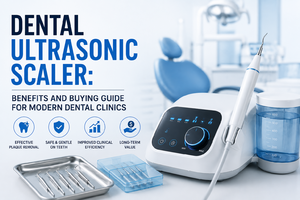
Dental Ultrasonic Scaler: Benefits and Buying Guide for Modern Dental Clinics

Dental Supplies Free Shipping: A Smarter Way to Save on Every Dental Order
Buy Dental Materials Online: A Step-by-Step Guide for Smarter Clinic Purchasing
Why Clinics Actually Stick With a Dental Supply Company Online Like Sky Dental Supply
Dental Supplies Online Store: A Complete Guide to Choosing the Right Supplier for Your Dental Practice
What is the Best Dental Cement for Crowns and Bridges
What’s the Best Dental Cement for Crowns and Bridges
Textured vs. Smooth Nitrile Gloves
Textured vs. Smooth Gloves: What Orthodontists Should Know
Ultrasonic scalers
Power scaling devices are either ‘sonic’, vibrating between 3,000 and 8,000 times per second, or ‘ultrasonic’, operating between 20,000 and 50,000 Hz. The ultrasonic ones tend to work better than the sonic kind, deplaquing and flushing the periodontal pocket well, and destroying bacterial cell walls with cavitating bubbles in their water streams. Ultrasonic scalers are either ‘magnetostrictive’, where energy is converted to elliptical strokes in the unit's metal rod, or ‘piezoelectric’, where strokes go in a linear pattern, back and forth, regulated by crystals in the ceramic handpiece.
Bands or crowns in space-maintaining orthodontia?
We’ve written before about choosing your orthodontic supplies. We said the key considerations are brand reputation, functional utility, durability, and quality of after-sale support.
Let’s do a little deep-dive.
One of the orthodontic things we supply is kits full of space-maintainer bands, for kids who lose molars early. As you know, the idea is to keep gaps open for the eruption of new molars. During this time, the concern is for good hygiene around those bands, for healthy gingiva.
High Definition Black Line Mirrors
Designed for enhanced performance, our HD Black Line Mirror is engineered to optimize clinical outcomes by delivering superior visibility throughout any dental procedure. The Diamond Like Carbon (DLC) coating of the handle and mirror frame reduces glare up to 80%!* The durable black matte finish in combination with the superior brilliance and color of our proprietary HD Mirror glass facilitates quicker and more accurate visibility of the mouth.
How Gingival Retraction Drives Restorative Excellence
Producing an exceptional restoration for a damaged tooth involves a series of complex, inter-related steps. When a set of restorations are completed together, such as for a smile makeover or full mouth rehabilitation, each step’s importance increases. One mismanaged piece can turn a masterpiece into a disaster. From planning to the final polish, the delivery of excellence rests on crucial principles.
3 Must-Have Tools For Successful Endodontics
Dentists face a challenging question every day: Should a damaged natural tooth be maintained with endodontic and restorative treatment, or should it be replaced with an implant? Implants continue to grow in popularity, and over five million implants are placed in the U.S. every year. But many times, endodontic therapy helps preserve a tooth and eliminates more invasive treatment.
More than 15 million root canals are completed annually in the U.S., and general dentists do nearly 11 million of them. Five million dental implants will be placed, too. Each situation requires a series of decisions to determine the best option.
Temporary Dental Cement Solutions: Six Unique Products That Save Time, Money, and Space
Dental cement products provide a critical tool for dentists to deliver exceptional clinical care. When fabricating a custom lab-based restoration, dentists need a reliable temporary cement during the interim period. But when the final restoration comes back from the lab, a temporary restoration must be easy to remove. And the new restoration needs adhesion that gives both the clinician and patient confidence for years of service.
5 Keys To Aerosol Reduction in Dental Settings
In dentistry, many procedures using high-speed handpieces and ultrasonic instruments produce aerosols, small droplets that suspend in the air. Viral particles, bacteria, and fungi can travel through aerosols, similar to what happens when someone sneezes. In some cases, these particles can go up to 20 feet and stay suspended in the air for several hours.
Dental staff who perform procedures on patients find themselves at risk or exposure to many pathogens. The highest risk develops from splatter to the face of clinicians and to the nasal region of patients. Periodontal procedures using ultrasonic and sonic instruments transmit the greatest number of droplets. Air polishing, use of the air/water syringe, and the operation of a high-speed handpiece also produce aerosols.
AMALGAM ALLOYS
A large number of dental restorative materials having different properties have been available in the market. Specialist dental professionals choose the required restorative materials according to the variable requirements intended in each patient. Dental amalgam alloys have been considered as the most commonly used restorative option since ages with the utmost durability and ease of manipulation. This alloy is a popular restorative biomaterial containing mercury in a liquid form in metal alloy forming a mixture. At skydentalsupply, Silver, tin, copper and traces of certain other metals in liquid mercury produce a mixture with great strength, durability, resistance to fracture and longevity which is much needed for restoring the molars involved in everyday chewing and mastication of food.